The south was hit by the heaviest rainfall this year: three warnings were issued in eight provinces.
Beijing, June 13 (Xinhua)-In the past few days, eight provinces including Zhejiang and Fujian have experienced the strongest rainfall this year, and the accumulated rainfall in some areas has even exceeded 800 mm. This round of heavy rainfall also caused more than 4.5 million people to be affected, and the Central Meteorological Observatory continued to issue a yellow rainstorm warning. It is estimated that the rain will come to an end on the 14th.
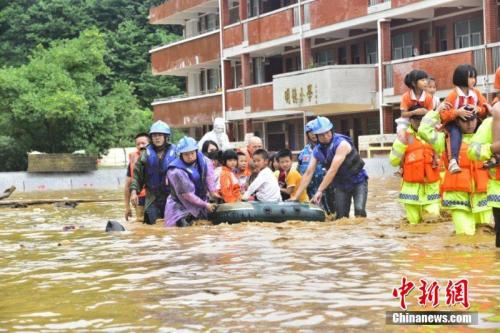
On June 9-10, heavy rain fell in longnan county, Jiangxi Province, and the teachers and students of Yangcun Town Central Primary School in the low-lying area of the county were trapped by the flood. As of 17: 00 on the 10th, all the 1309 teachers and students in the primary school were safely transferred. Text/Ye Bo Wang Jian Map/Ye Bo
The heaviest rainfall in the south this year has continued with three warnings.
Since the 6th, there has been continuous heavy rainfall in many places in the south, and most of the south of the Yangtze River, most of southern China and Guizhou have been widely affected. Eight provinces, including Zhejiang and Fujian, have suffered the strongest rainfall this year.
Among them, the cumulative rainfall in central and southern Hunan, Jiangxi, southern Zhejiang, northern and western Fujian, southern Chongqing, Guizhou, northwestern Guangxi, northern Guangdong and central and eastern China is 100 ~ 250 mm.
Qiannan and Anshun in Guizhou, Guilin and Liuzhou in Guangxi, Ji ‘an, Ganzhou, Fuzhou and Shangrao in Jiangxi, Quzhou in Zhejiang, Nanping and Sanming in Fujian, Heyuan in Guangdong and Guangzhou have 300-400 mm in some areas. The maximum rainfall in Ji ‘an, Jiangxi is 690 mm, and that in Guilin, Guangxi is 821 mm..
On the 12th, Jiangnan, South China, Guizhou, Yunnan and other places will be "occupied" by the ferocious heavy rainfall. At 18 o’clock that night, the Central Meteorological Observatory continued to issue a yellow rainstorm warning. At the same time, the Ministry of Natural Resources and the China Meteorological Bureau jointly issued a meteorological risk warning for geological disasters, and the Ministry of Water Resources and the China Meteorological Bureau jointly issued a meteorological warning for mountain torrents.
In addition, the Central Meteorological Observatory also issued a meteorological forecast of waterlogging risk.
It is estimated that from 20: 00 on the 12th to 20: 00 on the 13th, there will be heavy rain or rainstorm in most parts of Guangdong, the coastal areas in north-central Guangxi, southern Hunan, south-central Jiangxi, Fujian, southern Zhejiang, eastern Yunnan, northern Taiwan Province Island and northern Jilin.
Among them, there are heavy rains (100-240 mm) in the eastern and southern coastal areas of Guangdong, southeastern Hunan, southwestern Jiangxi, western Fujian and other places, with a maximum hourly precipitation of 30-50 mm and a local area of more than 60 mm, accompanied by strong convective weather such as thunderstorms and strong winds.

On June 10th, in Dukou Village, Meitang Township, Ji ‘an County, Jiangxi Province, firefighters waded waist-deep flood and carefully moved the baby to a safe place. Photo by Guo Qingyun
More than 4.5 million people in 8 provinces were affected. The national level IV emergency response to disaster relief continued to be maintained.
Heavy rainfall caused rivers in many places to skyrocket, waterlogging occurred in some urban areas, and a large number of farmland were flooded.
According to the news of China’s WeChat WeChat official account on the 12th, the strongest rainfall process in the south since the 6th this year has caused floods, windstorms, landslides, mudslides and other disasters in Zhejiang, Fujian, Jiangxi, Hunan, Guangdong, Guangxi, Chongqing and Guizhou, resulting in 4.532 million people in 249 counties (cities, districts) in 44 cities (autonomous prefectures) in 8 provinces (municipalities and autonomous regions) being affected.
At 10: 00 on the 9th, the National Disaster Reduction Committee and the Emergency Management Department launched the national level IV emergency response to the severe storms and floods in Ji ‘an, Shangrao and other places in Jiangxi Province, and sent a working group to the disaster area to inspect the disaster situation on the spot and guide and assist the local authorities in disaster relief.
At the same time, the Emergency Management Department urgently allocated 2,000 tents, 10,000 folding beds and 20,000 quilts and other central relief materials to the disaster-stricken areas to support the basic livelihood of the affected people.
As of the 12th, the National Disaster Reduction Committee and the Emergency Management Department maintained the national level IV emergency response, while the Ministry of Water Resources and the Yangtze River Committee maintained the level IV emergency response. The Working Group of the Emergency Management Department and the Working Group of the Ministry of Water Resources were still guiding in Jiangxi Province.
At the local level, Jiangxi Province maintains flood control level IV emergency response, Provincial Disaster Reduction Committee and Provincial Emergency Department maintain provincial level III emergency response, and 9 working groups of Provincial Emergency Department and 4 working groups of Provincial Water Resources Department are still centralized.
In addition, the Guizhou Provincial Department of Finance and the Guizhou Provincial Emergency Department have also allocated 4 million yuan of provincial-level natural disaster living allowance funds to Changshun, Luodian, Nayong and Jinsha counties, which have been seriously affected by natural disasters recently, to support the disaster-stricken areas to carry out disaster relief work such as emergency relocation and resettlement of the affected people and ensure the basic livelihood of the affected people.
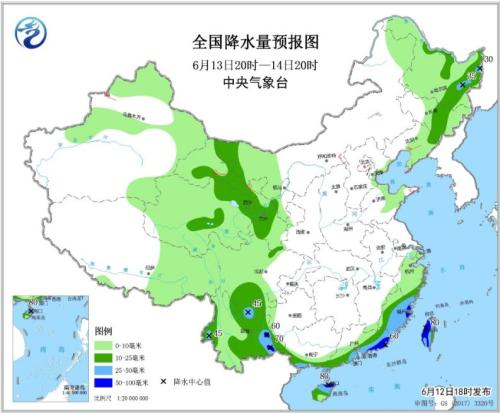
Heavy rainfall temporarily "retired" from the 14th.
When can this round of heavy rainfall "come to an end"?
According to the forecast of the Central Meteorological Observatory, until the 13th, there were heavy rainstorms in south-central Jiangnan, South China, Guizhou, eastern Yunnan and other places, heavy rainstorms in some areas, and local heavy rainstorms. The accumulated rainfall in some areas was 100-200mm, and the local area was more than 300mm.
On the 13th, rainfall in the south began to weaken, with moderate to heavy rain in parts of northeast China, south-central Jiangnan, southwest China, south-central South China and Taiwan Province Island. Among them, there were heavy rains or heavy rains (100-180 mm) in parts of south-central Zhejiang, northern and southern Fujian, eastern and southern Guangdong, southeastern Yunnan and most of Taiwan Province Island.
On the 14th, there was moderate to heavy rain in parts of southeastern Heilongjiang, eastern Qinghai, central and eastern Gansu, eastern and southern Southwest China, eastern and southern South China, Taiwan Province Island and other places, with local heavy rain (50-70 mm).
It is worth noting that due to the overlapping of the two heavy rains in the southern part of the Yangtze River and the northern part of South China, and the short interval, special attention should be paid to preventing the occurrence of secondary disasters such as flash floods and landslides.
After the current round of precipitation, from 16th to 19th, there was an obvious rainfall process from west to east in the eastern part of southwest China, Jianghan, Jiangnan and western South China.
In addition, according to the latest monitoring by the National Climate Center, the rainy days and rainfall in Jiangnan District reached the standard of entering Meiyu in 2019, and it has been confirmed that it entered the Meiyu period on June 5, three days earlier than normal.
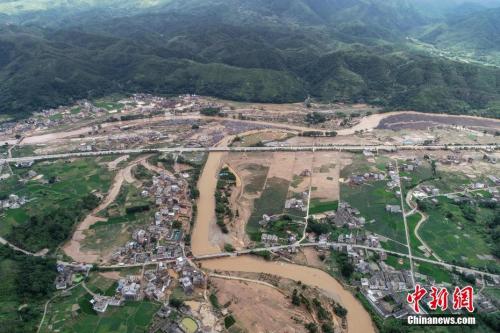
According to the statistics of the office of flood control, drought prevention and wind prevention headquarters in Heyuan City, Guangdong Province, as of June 11, heavy rain caused 63 towns and villages in Heyuan City to be affected to varying degrees. The picture shows Shangping Town, Lianping County, Heyuan City, Guangdong Province under the aerial camera. China News Service reporter Chen Yushe
How to prevent accidents in heavy rain?
Summer is the season of high rainstorm. How to deal with the rainstorm? On the 12th, the official WeChat of the Emergency Management Department released a "Summer Rainstorm Survival Guide".
The Guide reminds people that when there is heavy rain in their area, the best choice is to stay at home. If you live in a low-lying area or your house is old, you must move to a high and safe place.
If you have to go out as a last resort, you should avoid iron towers, telephone poles and billboards. If there is deep water on the road, it is best for pedestrians to take a stick to explore the road ahead to avoid falling into the sewer. Don’t get close to the high-voltage wire tower if it is tilted or the wire is broken and drooping, so as to prevent electric shock.
In addition, buses are safer than private cars when going out in heavy rain. If you need to drive, you must avoid underpasses and muddy low-lying areas during driving. Generally, the depth of accumulated water is 10-20CM, which is safe, but if the depth of accumulated water exceeds 20CM, don’t venture through.
If the car stalls halfway through driving, don’t start it again. Before the water overflows the door, stall and close the door and leave the car. In case of being flooded, you can successfully get out of danger by breaking the side window with a safety hammer.