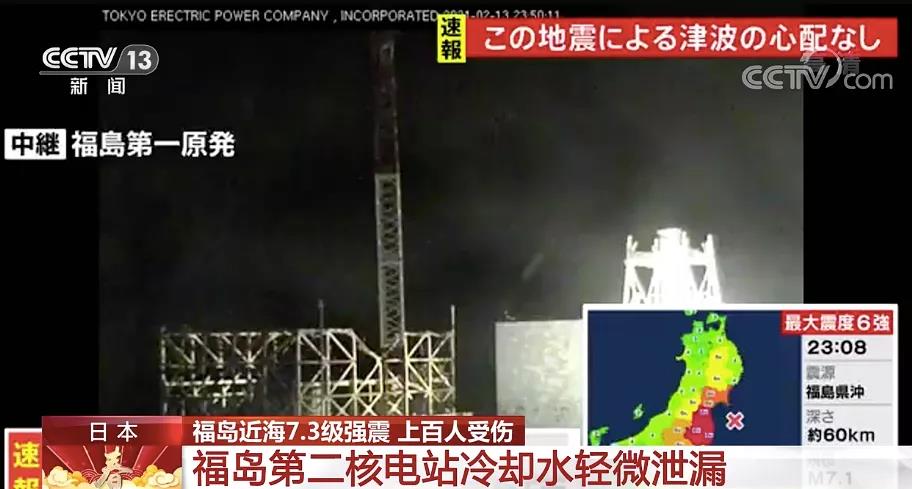
Shake violently! A strong earthquake of magnitude 7.3 in Japan has injured 100 people.

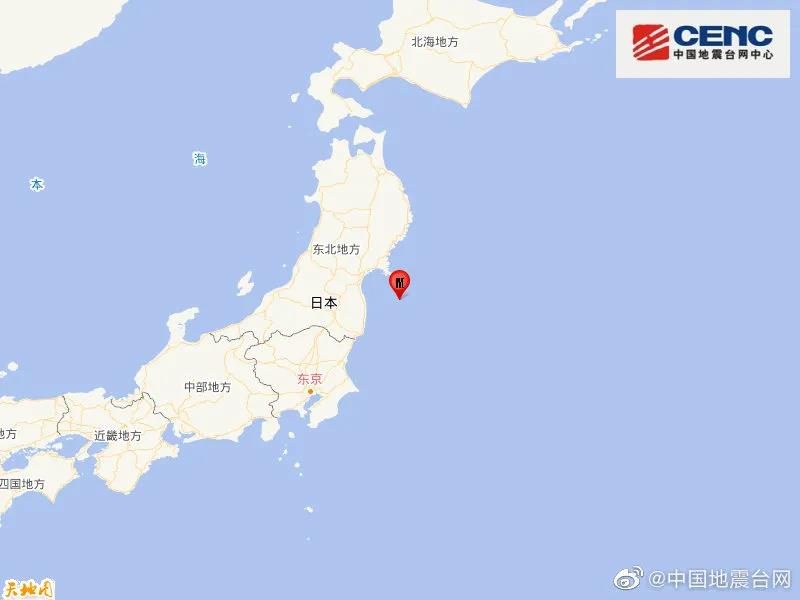
  On the evening of 13th local time, a strong earthquake of magnitude 7.3 occurred in the eastern waters of Fukushima, Japan, with a focal depth of 55km. After the earthquake, the Japan Meteorological Agency did not issue a tsunami warning. According to Japanese media reports, the earthquake has caused more than 100 injuries in Fukushima Prefecture and Miyagi Prefecture.

  Japan has a strong sense of earthquakes.

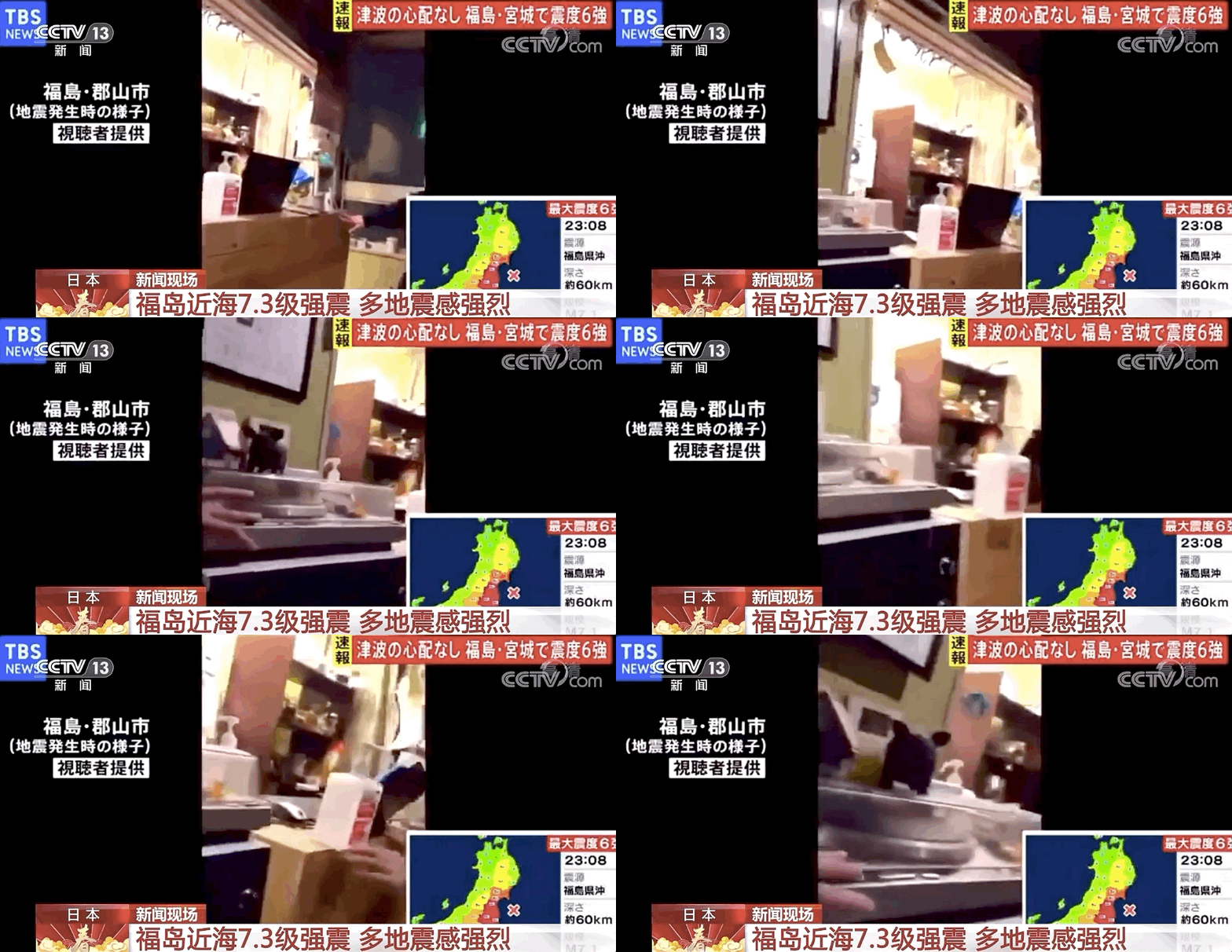
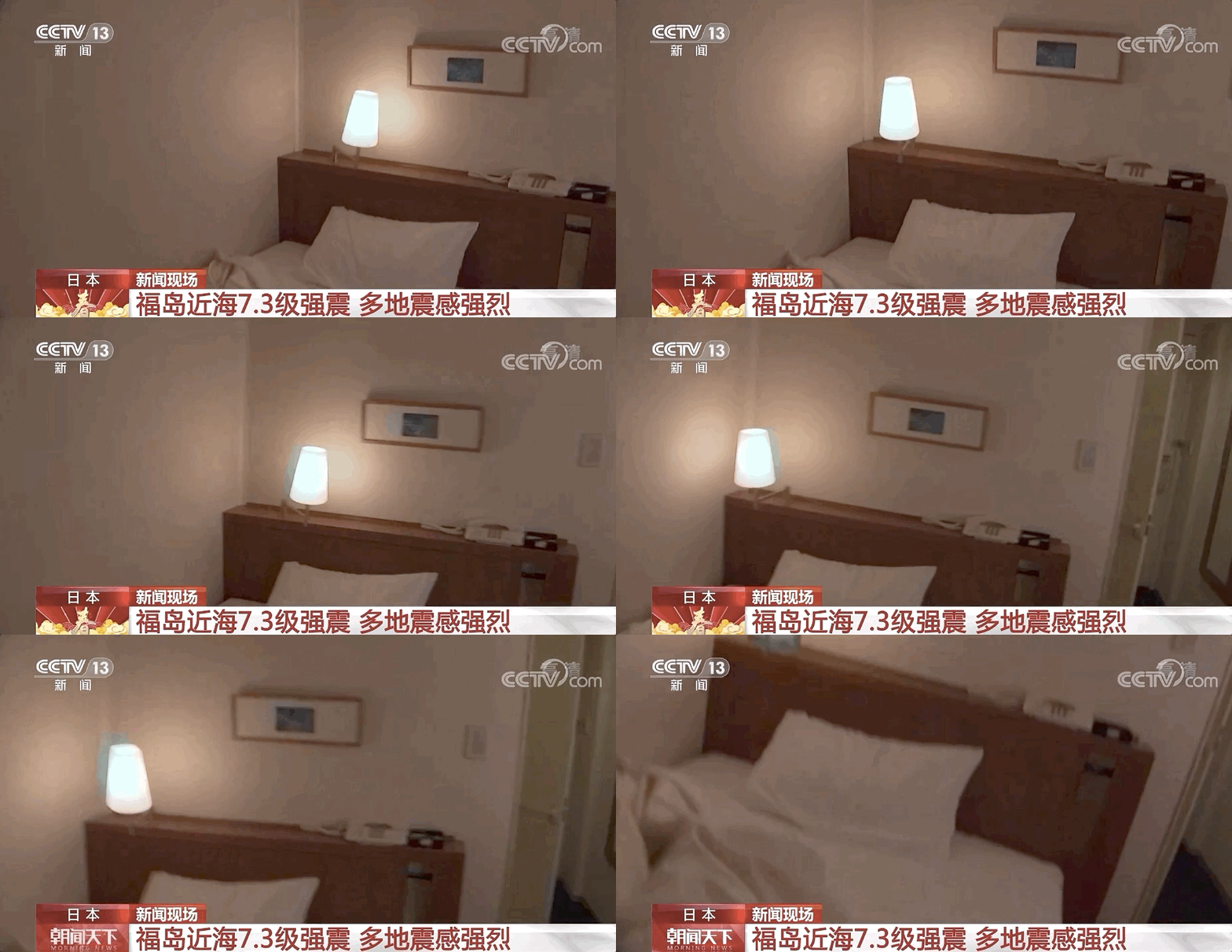
  There are many earthquakes in Japan, and many people say that this earthquake is the strongest since the "March 11" earthquake in 2011. According to the scene picture, when the earthquake struck, many places shook obviously.

△ This picture was taken in Koriyama City, Fukushima Prefecture at the time of the earthquake.

  △ At the time of the earthquake, a hotel in Iwaki City, Fukushima Prefecture.

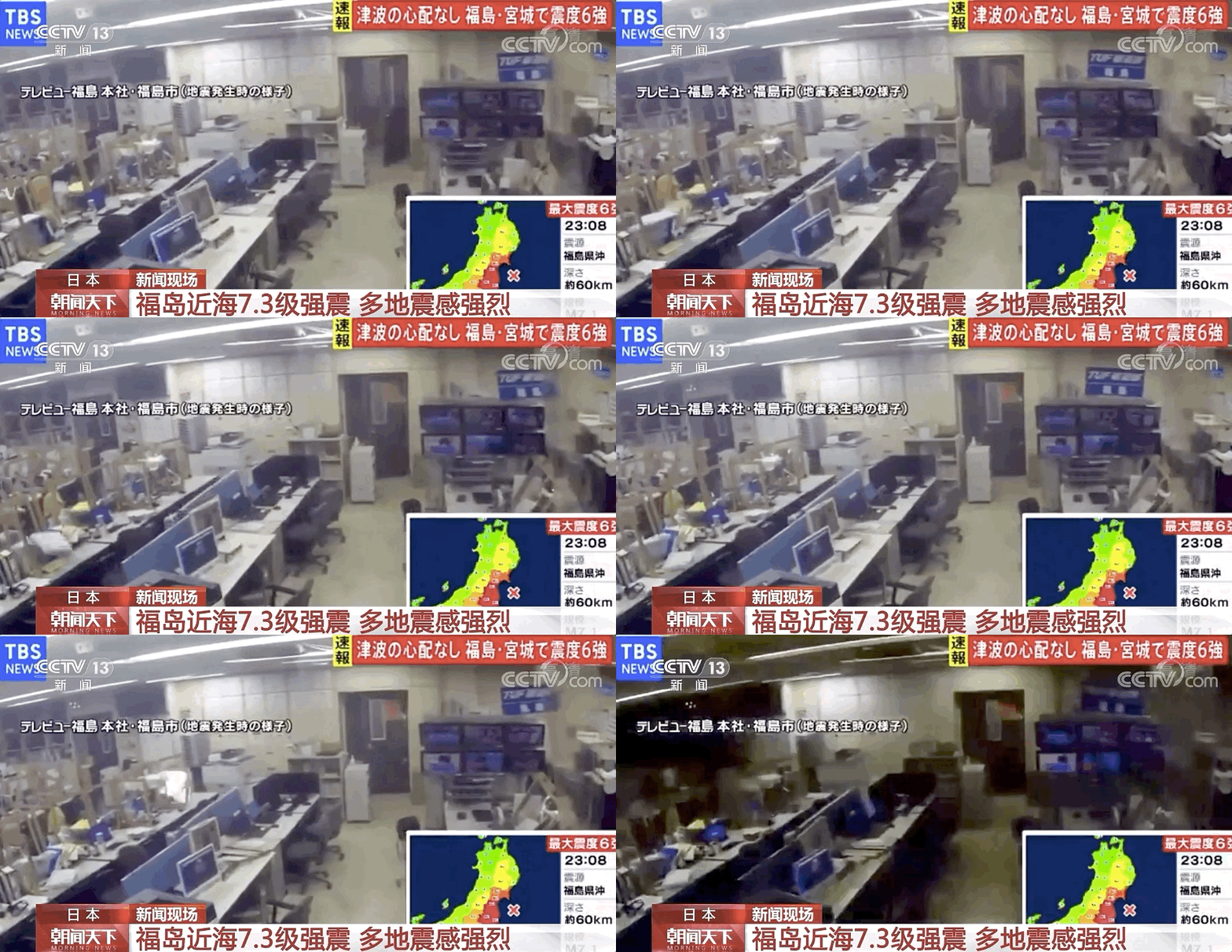
△ When the earthquake struck, the scene inside a TV station in Fukushima City, Fukushima Prefecture.

  Judging from this picture taken by the camera on a local TV station building in Fukushima Prefecture, the shaking lasted for more than 1 minute when the earthquake occurred.

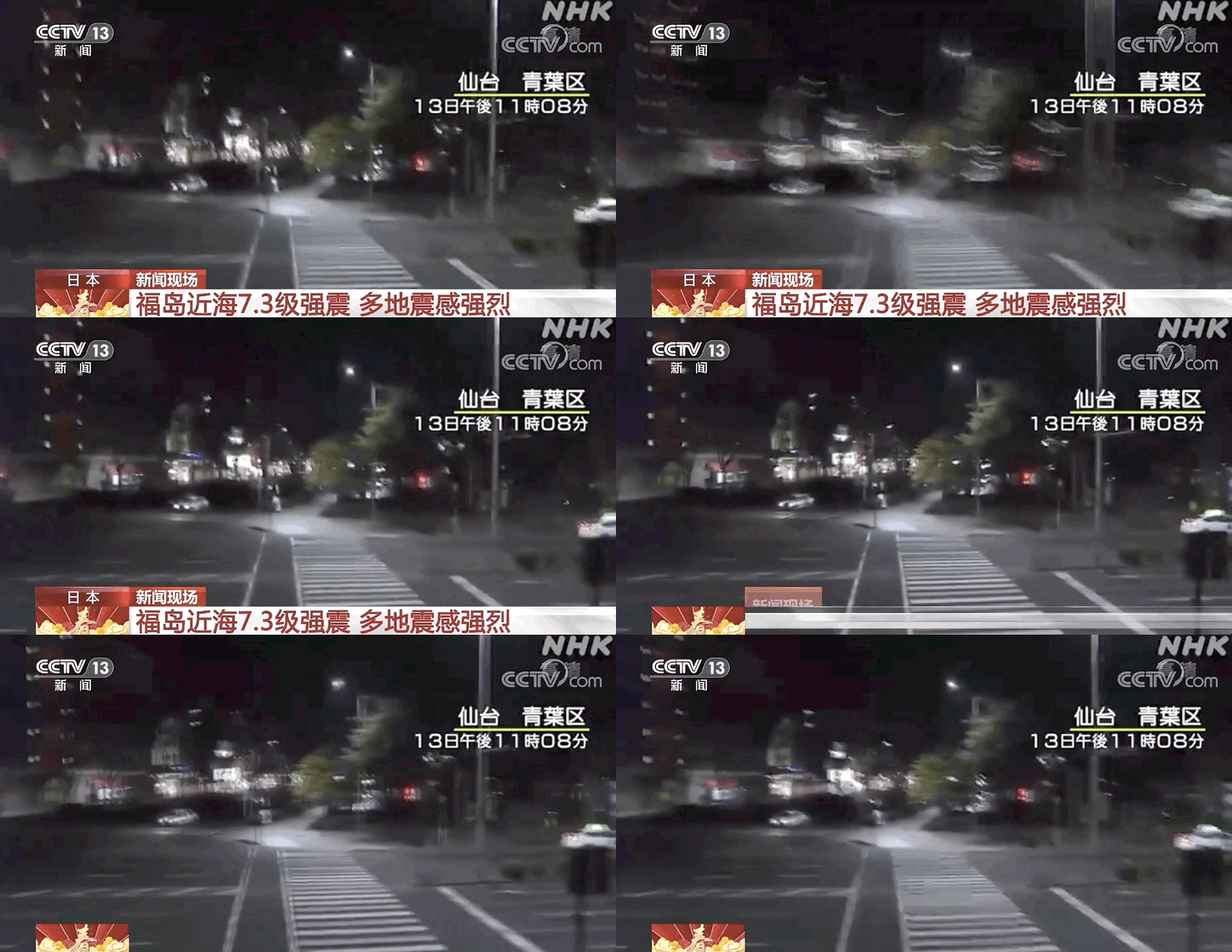
  The road in Sendai City, Miyagi Prefecture, which is adjacent to Fukushima Prefecture, is also shaking badly.

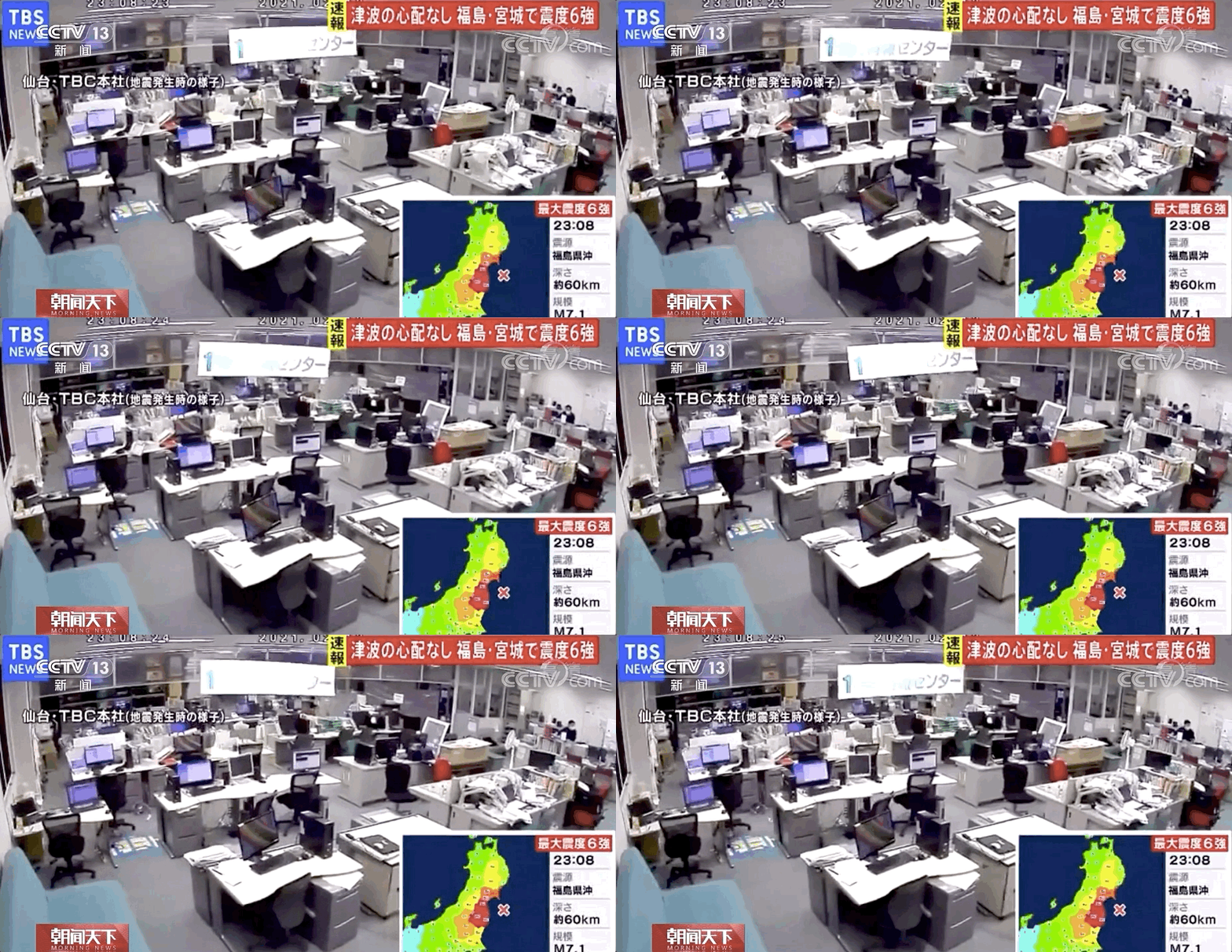
  The office of the Tokyo Broadcasting Corporation in Sendai City Branch was also in a mess due to strong shaking.

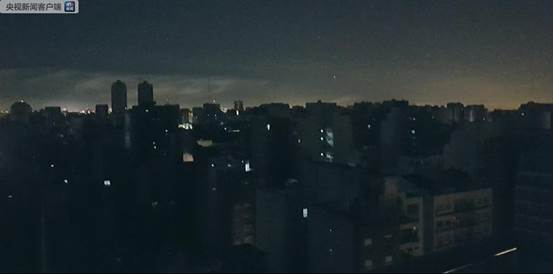
  The earthquake caused a large area of power failure and water cut, and some rail transit was suspended.

  The earthquake caused large-scale power and water cuts in many places in Japan, and at least 10 thermal power generating units in Northeast China suspended power generation. Early warning of geological disasters was issued in the area where the epicenter was located, and landslides have occurred in Fukushima Prefecture.

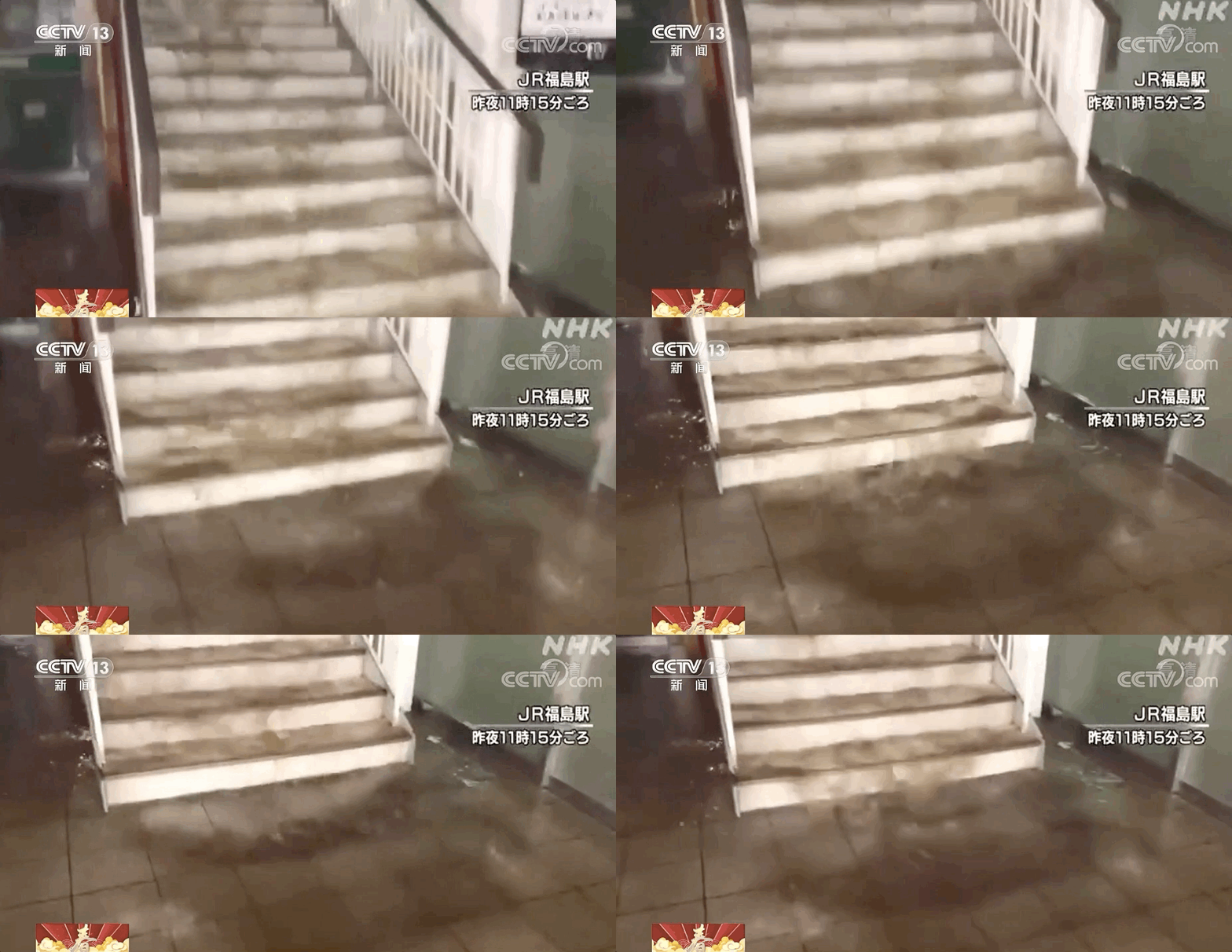
  Some sections of the Shinkansen in Tohoku, Shangyue, Hokuriku and Tokaido in Japan were temporarily suspended due to power outages. The pipeline of JR station in Fukushima City, Fukushima Prefecture was damaged and leaked a lot.

  Some residents of Fukushima City went to convenience stores to buy materials urgently after the earthquake.

  The maximum magnitude of this earthquake is "Top 6" or the aftershock of "March 11th" earthquake.

  The largest earthquake was "Top 6", and nearly half of Fukushima Prefecture and the whole neighboring Miyagi Prefecture were "Top 6". According to the earthquake classification method set by Japan Meteorological Agency, from weak to strong, it is divided into 10 grades, the strongest is "7", followed by "6".

  The Japan Meteorological Agency believes that this earthquake may be the aftershock of the "3.11" earthquake in 2011, and strong earthquakes may still occur in the past two or three days or even the next week to remind residents to pay attention to safety.

  The cooling water of Fukushima second nuclear power plant leaked slightly.

  Confirmed by Tokyo Electric Power Company, the nuclear power plants in Fukushima area have been out of service since the "March 11" earthquake. After the earthquake on the evening of the 13th, the Fukushima Daiichi nuclear power plant did not report changes in radiation monitoring data. There is no obvious abnormality in the equipment of Nagawa Nuclear Power Station in Miyagi Prefecture, and the radiation monitoring data has not changed; There are no abnormalities in the Donghai No.2 Nuclear Power Plant in Ibaraki Prefecture and the Kashiwazaki Yuki Nuclear Power Plant in Niigata Prefecture.

  However, according to NHK TV, the cooling water used to store nuclear fuel in Unit 1 of Fukushima No.2 Nuclear Power Plant leaked slightly, but the radiation amount was said to be very low.

  Suga Yoshihide instructed to spare no effort in disaster relief.

  After the earthquake, the Japanese government set up a bureaucratic countermeasure room in the crisis management center of the Prime Minister’s official residence, a disaster prevention headquarters in the police department, and disaster countermeasures headquarters in Fukushima and Miyagi counties.

  Japanese Prime Minister Suga Yoshihide instructed to grasp the disaster situation as soon as possible, and hoped that all localities would cooperate closely and spare no effort in disaster relief. Japanese Defense Minister Nobuo Kishida has asked the Self-Defense Forces to do a good job in disaster response.

"Second Exposure" released stills Fan Bingbing, Huo Siyan playing ambiguous underwater


Fan Bingbing and Huo Siyan underwater beautiful stills

    Directed by Li Yu and produced by Fang Li, the film starring Fan Bingbing, Feng Shaofeng, and Huo Siyan will be released nationwide on September 29. A few days ago, the beautiful stills in the water of the two heroines Fan Bingbing and Huo Siyan were officially exposed.

Fan Bingbing and Huo Siyan go into the water for 6 hours in cold winter

    It is reported that during the shooting of this group of underwater shots, in order to create a visual effect of the "lake" in reality, the crew specially placed a circular rockery in the underwater studio and put a lot of algae. Because it was already the cold winter weather in Beijing in November, before the actors went into the water, they had installed hot water heating pipes underwater. Unexpectedly, the originally warm water, because the algae blocked the heating pipe opening, made the temperature in the water get colder and colder with time. However, due to the needs of the plot, both Fan Bingbing and Huo Siyan had to go into the water in tulle skirts and suspender skirts. In addition to overcoming the cold water temperature and uncontrollable underwater buoyancy, the two also had to pose a beautiful and elegant POSE to capture. The two had no complaints about this and dived into the water again and again to run in the action. At the same time, because of their thin clothes, both Fan Bingbing and Huo Siyan were scratched by sharp parts on the rockery to varying degrees in the water, but they did not care about the pain. After 6 hours of water immersion, the two finally completed all the scenes required by the director with dedication and professionalism. After getting out of the water, the crew immediately served hot ginger soup to keep the two warm.

Next page:Fan Bingbing and Huo Siyan premiere "Dangerous Girlfriend"

Beijing adjusts and optimizes the purchase policy, and the down payment ratio of the first suite is reduced to 30%

  On December 14th, Beijing Municipal Commission of Housing and Urban-Rural Development issued "Further Optimizing and Adjusting Real Estate Policies in this Municipality to Better Support Rigid and Improved Housing Demand". The full text is as follows:

  On July 24th, the Political Bureau of the Central Committee held a meeting and pointed out that it is necessary to adapt to the new situation that the relationship between supply and demand in the real estate market has undergone major changes, adjust and optimize real estate policies in a timely manner, better meet the rigid and improved housing needs of residents, and promote the stable and healthy development of the real estate market. On August 18th, the Ministry of Housing and Urban-Rural Development and other departments issued the Notice on Optimizing the Criteria for Determining the Number of Housing Units in Personal Housing Loans. On August 31st, the People’s Bank of China and other departments issued the Notice on Adjusting and Optimizing the Differentiated Housing Credit Policy, which unified the lower limit of the minimum down payment ratio of the first and second sets of commercial personal housing loans to not less than 20% and 30%, and adjusted the lower limit of the interest rate policy of the second set of commercial personal housing loans. According to the spirit of the meeting and the requirements of the document, on September 1st, Beijing optimized and adjusted its real estate policy, and introduced the policy of "recognizing houses but not loans".

  In order to implement the spirit of the Central Economic Work Conference, on the basis of adhering to the positioning of "housing and not speculating", according to the recent changes in the real estate market in Beijing, combined with the implementation of the new urban master plan, on December 14, The Beijing Municipal Commission of Housing and Urban-Rural Development, the Beijing Taxation Bureau of the State Administration of Taxation, the Beijing Branch of the People’s Bank of China, the Beijing Supervision Bureau of the General Administration of Financial Supervision and the Beijing Housing Provident Fund Management Center jointly issued the Notice on Adjusting and Optimizing the Ordinary Housing Standards and Individual Housing Loan Policies in this Municipality (hereinafter referred to as the Notice), optimizing the identification standards of ordinary housing (hereinafter referred to as ordinary housing), lowering the minimum down payment ratio of newly issued individual housing loans and extending the longest loan period; At the same time, the self-discipline mechanism of market interest rate pricing in Beijing has also adopted a self-discipline resolution to lower the lower limit of interest rate policy for newly issued commercial personal housing loans, which better supports the rigid and improved housing demand in Beijing.

  The "Notice" clarifies that the criteria for the identification of ordinary houses should be optimized. The current standard of general housing in Beijing was released in 2014, which has a certain gap with the actual market situation, and the public’s response is relatively concentrated. This adjustment, combined with market changes, has appropriately raised the construction area and price standard of ordinary houses. After adjustment, the plot ratio of residential buildings is above 1.0 (inclusive), the single building area is below 144 square meters (inclusive), the transaction price in the 5th ring is below 85,000 yuan/square meter (inclusive), the transaction price in the 5th-6th ring is below 65,000 yuan/square meter (inclusive), and the transaction price outside the 6th ring is below 45,000 yuan/square meter (inclusive). The proportion of ordinary houses in the city has increased to about 70%, and more families will be able to enjoy the preferential policies of value-added tax when housing is transferred.

  The "Notice" proposes to reduce the minimum down payment ratio of new mortgage loans and extend the loan term. On the basis of the unified national policy, the minimum down payment ratio of the first set of housing personal housing loans (including commercial personal housing loans and housing provident fund personal housing loans, the same below) in Beijing will be reduced to 30%; The minimum down payment ratio of individual housing loans for two sets of housing will be reduced to 50% in six urban districts and 40% in six non-urban districts. Lowering the minimum down payment ratio reduces the threshold for residents to purchase housing, which is conducive to better meeting the demand for rigid and improved housing. At the same time, this adjustment has cancelled Beijing’s strict control over the mortgage period during the excessive upward trend of housing prices, from the current maximum of 25 years to 30 years.

  In addition, this adjustment will also lower the lower limit of the new mortgage interest rate policy of commercial banks. This adjustment is the lower limit of interest rate policy for newly issued commercial personal housing loans, that is, the new lower limit of interest rate policy will be implemented for newly issued commercial personal housing loans from December 15. After adjustment: the lower limits of the first and second sets of interest rate policies in Chengliu District are not less than the quoted loan market interest rate of the corresponding term plus 10 basis points, and not less than the quoted loan market interest rate of the corresponding term plus 60 basis points respectively; The lower limits of the first and second sets of interest rate policies in non-urban six districts are not less than the quoted interest rate of the loan market for the corresponding term and not less than the quoted interest rate of the loan market for the corresponding term plus 55 basis points respectively. Banks should reasonably determine the interest rate level of each new mortgage according to the policy lower limit determined by the self-discipline mechanism of market interest rate pricing in Beijing, combined with the operating conditions of their institutions, customer risk conditions and other factors, and in accordance with the principles of marketization and rule of law.

[Video] What are the hidden dangers behind the small "cigarette card"?

editorial comment/note

In order to thoroughly study and implement the supreme leader’s thought of the rule of law and the supreme leader’s cultural thought, explore and cultivate Shandong’s high-quality new media accounts and works, better use the new media to reflect the procuratorial responsibility of "running every case well with high quality and efficiency", and effectively serve the modernization of Shandong’s procuratorial work, from May 17, Lu Jianjun will display the excellent new media works of the procuratorial organs in the province, so please pay attention.

Beautiful appearance of "cigarette card"

Novel folding method

The thrill of winning or losing a "cigarette card"

Attract many minors.

But the harm caused by "cigarette card"

should not be underestimated

It is even more necessary to be vigilant.

Click on the video below

Let’s get to know each other with the D.A.

Warm reminder

"Cigarette card" is a derivative of tobacco products. It seems that the game of "cigarette card" can enhance friendship and promote interaction, but the hidden harm is not small. It is necessary for children to correctly understand the "cigarette card" game, consciously guide them to go outdoors, experience more activities beneficial to the body and mind, and feel the joy of life, so as to leave colorful memories for their childhood.

Guiding unit: Shandong Provincial People’s Procuratorate

Produced by Qihe County People’s Procuratorate

Original title: "[Video] What are the hidden dangers behind the small" cigarette card "? 》

Read the original text

(This article is from The Paper, please download the "The Paper" APP for more original information)

Some legal professionals in Hong Kong actually staged a silent procession in black to protest against the interpretation of the law.

[Observer Network Synthesis] On the 7th, the National People’s Congress Standing Committee (NPCSC) unanimously passed the interpretation of Article 104 of the Basic Law. According to a report by Hong Kong Dagong. com on November 9th, the China-Australia Law Exchange Foundation held a press conference on the 8th to support the NPC’s interpretation, arguing that the interpretation filled the vacuum of the common law and did not affect the judicial independence of Hong Kong, stressing that the interpretation was for the benefit of Hong Kong and national sovereignty, and the result was beneficial to the whole Hong Kong society. The Law Society of Hong Kong also issued a statement expressing full confidence in the proper operation of Hong Kong’s judicial system.

However, some legal professionals in Hong Kong were dissatisfied with this and staged a protest.

On November 8, the China-Australia Law Exchange Foundation emphasized that the National People’s Congress interprets the law for the benefit of Hong Kong and safeguarding national sovereignty/source: Dagong.com.

He also took out the tricks of marching and silence.

According to Hong Kong Ming Pao reported on November 8, following the statement of the Hong Kong Bar Association expressing dissatisfaction, the legal profession in Hong Kong launched a black dress parade at 5: 45 pm on the 8 th, from the High Court in Admiralty to the Court of Final Appeal in Central.

The March was initiated by Guo Rongkeng, a member of the Legislative Council of Hong Kong Citizens Party, and attended by many legal professionals, including former chairmen of the Bar Association, Martin Lee and Yu Ruowei, chief lecturer of the School of Law of the University of Hong Kong, and barrister Margaret NG. They just marched in silence and didn’t shout slogans along the way. By 6 pm, there were hundreds of people on the scene, and most of the participants were dressed in black.

It is said that about 2,000 people participated in the parade, most of whom were legal professionals. The police said that there were 1,700 people at the peak.

The tail of the procession arrived outside the Court of Final Appeal at 6: 48 pm. All the marchers were declared silent for three minutes by Martin Lee. Later, after Martin Lee paid a simple tribute to the marchers, the procession ended in silence.

As the leader of the opposition in Hong Kong, Martin Lee often goes abroad to "criticize Hong Kong" and takes the initiative to attract foreign forces to intervene in Hong Kong as a "common practice". In recent years, he has frequently gone out to "ask for help" on the topic of political reform. However, he was not given the cold shoulder once or twice in a foreign country. According to the Hong Kong Sing Tao Daily reported on October 22nd, Martin Lee and the former Chief Secretary for Administration of Hong Kong, Anson Chan, were scheduled to meet with New Zealand Deputy Prime Minister english on October 18th, but they received an email on the evening of 17th and were told to cancel the arrangement. Lin Dahui, a former member of the Legislative Council of Hong Kong, criticized this behavior, saying that it is absolutely understandable that a family has different internal opinions, but it is absolutely wrong to intervene in Hong Kong’s internal affairs with the help of foreign forces, and most Hong Kong people will not accept and agree with it.

Former Chairman of the Hong Kong Bar Association, founder of the Democratic Party, Martin Lee (right), Member of the Legislative Council of Hong Kong Citizens Party, Guo Rongkeng (left)/Source: Hong Kong Ming Pao

Hong Kong legal profession black silent procession scene/Source: Hong Kong Ming Pao

Hong Kong barrister Margaret NG/Source: Hong Kong Ming Pao

Martin Lee said that this interpretation of the law has impacted the rule of law and the Legislative Yuan in Hong Kong. The Standing Committee of the National People’s Congress has the right to interpret the law, but it has no right to interpret the laws of Hong Kong, including the Oaths and Declarations Ordinance. The NPC is helping the Legislative Council of Hong Kong to legislate and amend laws.

Professor Chen Wenmin, former dean of the Law School of the University of Hong Kong, told the US media before the March that the impact of the NPC interpretation on Hong Kong’s judicial system was "the most severe", especially before the Hong Kong High Court took the oath to review the judgment. This interpretation was a solution to the problems that Hong Kong courts could have solved, which "overthrew the rule of law in Hong Kong" and seriously weakened the confidence of the international community in Hong Kong’s "one country, two systems".

Before the March began, Cherish Group and other groups gathered outside the High Court to support the NPC’s interpretation of the law and demanded that Liang Songheng and You Huizhen, two members of the "New Youth Deal", be disqualified.

Earlier, the Hong Kong Bar Association issued a statement on the 7th, saying that it deeply regretted the NPC’s interpretation of the law.

Chen Wenmin, former Dean of the Law School of the University of Hong Kong/Source: Hong Kong Ming Pao

Hong Kong legal profession: Interpretation of the law is not illegal construction, and the power of interpretation comes from the Constitution.

According to the news of Dagong.com on November 8th, the China-Australia Law Exchange Foundation held a press conference on the 8th, attended by barristers Manguo and Ding Huang, and three lawyers, namely Qian Zhiyong, Ye Xinying and Jian Songnian.

Ma Enguo, chairman of the Foundation, said that the Court of Final Appeal had stated that the interpretation of the the National People’s Congress Standing Committee (NPCSC) law was binding and overriding to all courts in Hong Kong, and after the previous interpretation of the law, the court’s judgment did not point out that the interpretation would affect the judicial independence of the courts in Hong Kong. He criticized people in the legal profession, including the Bar Association, for pointing out that judicial independence was affected.

Marne: Governing "Hong Kong Independence" by Law

The Commonwealth of Man also pointed out that in common law case law, there is no case in local, British, Australian or even Canadian case law about how to take an oath to be qualified, so the judge has no precedent to follow. He can only make a judgment based on "refusing or ignoring" the oath in Article 21 of the Oaths and Declarations Ordinance and "taking an oath according to law" in Article 104 of the Basic Law, which requires inference to explain what "taking an oath according to law" means, and this interpretation has filled this piece of law.

Ma Enguo believes that from the national level, it is also necessary to interpret the law, because the words and deeds of Liang Songheng and You Huizhen, the new youth policy, unreservedly bring out anti-China and "Hong Kong independence" thinking, which represents "Hong Kong independence" in Hong Kong politics. If the central government does not express its position, it will have an impact on national sovereignty and territorial integrity. He emphasized that the state governs the country according to law and "Hong Kong independence" by law, so that laws must be followed and law enforcement must be strict. If the "Hong Kong independence" action is further escalated, he does not rule out that the central government will take action to deal with "Hong Kong independence".

Jian Songnian refutes the theory of "unauthorized construction"

As for some opponents who say that the interpretation of the Basic Law is a modification and unauthorized construction of the Basic Law, Jane Songnian, a member of the Chinese People’s Political Consultative Conference, refutes that the interpretation of the Basic Law does not add, delete or modify a word in Article 104 of the Basic Law, but only explains the meaning of the word "law" in "according to law". "Wouldn’t it be more convincing for legislators to explain the original legislative intent themselves? How can it be said that it is illegal? "

Asked if the Oaths and Declarations Ordinance can deal with the swearing-in of Members, is it still necessary to interpret the law? In a radio interview yesterday, Chen Hongyi, a member of the Basic Law Committee, said that the central government’s considerations are not only legal, but also political, including that those who advocate "Hong Kong independence" will enter the Legislative Council, which will impact the bottom line of "one country, two systems" and the central government will release information. If "one country, two systems" continues, it will not tolerate transcendence or challenges.

In addition, the Law Society of Hong Kong also issued a statement on the interpretation of the Basic Law, expressing its recognition that the power of interpretation of the Basic Law belongs to the National People’s Congress Standing Committee (NPCSC), and it is full of confidence that the judicial system of Hong Kong can operate properly under the "one country, two systems" principle.

Political and legal experts: a heavy blow to the "independence" flame

Yesterday, the Hong Kong and Macao Basic Law Research Center of Shenzhen University held an academic salon to discuss the NPC’s decision to interpret the law. Experts and scholars in Shenzhen and Hong Kong have said that the NPC’s interpretation of the law is an important part of the rule of law in Hong Kong, and its legitimacy, authority and legitimacy are beyond doubt. This NPC interpretation is very timely and necessary, which not only conforms to Hong Kong’s public opinion of opposing "Hong Kong independence" and safeguarding national sovereignty, but also deals a heavy blow to the arrogance of "Hong Kong independence" elements. Some experts clearly pointed out that the interpretation of the law is not an act divorced from the legal system and cannot be "demonized". Refusing the interpretation of the law by the National People’s Congress is a denial of national sovereignty.

Zou Pingxue, director of the Hong Kong and Macao Basic Law Research Center of Shenzhen University, pointed out that this interpretation of the NPC clarified the legislative intent and legal principles of Article 104 of the Basic Law, which can effectively solve the current legal disputes caused by the swearing-in storm of the elected members, better regulate all future SAR candidates for statutory public office and their swearing-in behaviors, and legally build a "firewall" to strictly curb any illegal acts such as deliberately violating the statutory requirements of swearing-in, flouting the swearing-in procedure according to law, and even advocating "Hong Kong independence" to insult the country and the nation.

Zou Pingxue said that the NPC’s interpretation of the law used legal weapons to punish the illegal acts of "Hong Kong independence" in a timely manner according to law, which dealt a heavy blow to the arrogance of "Hong Kong independence" elements, helped restore the damaged rule of law order, effectively safeguarded "one country, two systems" and effectively safeguarded the authority of the Constitution and the Basic Law. The interpretation of the law by the National People’s Congress once again shows the central government’s initial intention of adhering to "one country, two systems" and its determination to keep "one country, two systems" unchanged. It is unambiguous and unwavering in fulfilling the constitutional responsibilities entrusted by the Constitution and the Basic Law and exercising the constitutional powers entrusted to the central government by the Constitution and the Basic Law.

Guo Zhenglin, deputy director of the Shenzhen Training and Research Center of the Liaison Office, said that the fundamental purpose of the central government’s policies towards Hong Kong is to safeguard national sovereignty, security and development interests and maintain Hong Kong’s long-term prosperity and stability. This is also the core requirement and basic goal of the principle of "one country, two systems". Every interpretation of the law by the central authorities is a constitutional and legal act to revolve around and implement this purpose. Practice has proved that every interpretation of the Basic Law by the Central Committee has solved the problems that the Hong Kong SAR itself cannot solve, ensured the overall stability of Hong Kong and promoted the healthy development of Hong Kong’s politics and economy. This interpretation of the Basic Law by the National People’s Congress once again clarified the bottom line of "one country, two systems", exposed the essence of "Hong Kong independence" forces splitting the country and destroying Hong Kong, determined the political rules of public officials in the SAR, and paved the way for Hong Kong to make every effort to govern.

Kin-Chung Ho, assistant research director of the Hong Kong Policy Research Institute and former political assistant to the Director of the Development Bureau of the Hong Kong SAR Government, said that the interpretation of the law is not an act divorced from the legal system and cannot be "demonized". Refusing the NPC to interpret the law is a denial of sovereignty. As for some people who think that the interpretation of the NPC affects judicial independence, Kin-Chung Ho thinks that as long as a judge can judge a case within the scope of his duties with his free will, it is judicial independence. Whether his judgment will be overturned by a higher court or the interpretation of the NPC has nothing to do with independence.

As for the process of court hearing, should the Standing Committee of the National People’s Congress interpret the law? Kin-Chung Ho said that the NPC Standing Committee’s action during the trial was really a last resort and would not set a so-called "precedent".

The power of interpretation of the NPC comes from the Constitution.

Ling Youshi, former senior research director of the Central Policy Unit of the Hong Kong SAR Government, pointed out that the NPC’s timely and active interpretation of the law has set a very good practice model, and what needs to be concerned is whether the interpretation of the law can produce more positive and accurate effects in the future. She pointed out that as for the commissioner for oaths, according to Article 43 of the Basic Law, the commissioner for oaths should be the Chief Executive. Many of the rules of procedure of the Legislative Council are inconsistent with the provisions of the Basic Law and should be amended. Lin Qibin, a partner of Dong Wuxie Hong Kong Law Firm, said that the NPC’s power to interpret the law comes from the Constitution, and the NPC has the right to interpret the Basic Law, rather than interpreting it according to the authorization of the Basic Law. This is a top-down relationship and cannot put the cart before the horse.

Interpretation of the Basic Law conforms to the fundamental interests of Hong Kong and safeguards national sovereignty.

Li Fei, Deputy Secretary-General of the National People’s Congress Standing Committee (NPCSC), insisted at a press conference on November 7th that "the National People’s Congress does not interfere with the judicial independence of Hong Kong", and that the interpretation of the law is to uphold the law, stressing that the independent judicial power and the power of final adjudication of the Hong Kong Special Administrative Region are endowed by the Basic Law, and there can be no judicial independence beyond the Basic Law.

Leung Chun-ying, the Chief Executive of Hong Kong, held a press conference on November 7th to express his support for the interpretation of the Basic Law by the National People’s Congress. The Hong Kong SAR Government and the general public must stop any act that deliberately violates the above-mentioned (oath) provisions, flouts the swearing-in procedure according to law, or even takes the opportunity to insult the nation and advocate splitting the country or sovereignty.

A spokesman for the Hong Kong and Macao Affairs Office said on the 7th that "Hong Kong independence" elements would never be allowed to enter the organs of political power, and the head of the Liaison Office also said that the interpretation of the law would help to resolve the disputes caused by some members-in-waiting of the Hong Kong Legislative Council swearing in violation of the law, safeguard national security, crack down on and contain the "Hong Kong independence" forces, and ensure that the practice of "one country, two systems" in Hong Kong will not be distorted.

In addition, the Hong Kong media also supported the NPC’s interpretation of the Basic Law, believing that this interpretation was not only timely, but also the best way to completely resolve related disputes. Hong Kong people also organized rallies to support the NPC’s interpretation of the Basic Law.

In addition, in response to a statement made by the Taiwan Province Mainland Affairs Council calling on the mainland to keep its promise to Hong Kong, the Taiwan Affairs Office of the State Council responded strongly on the 8th, saying that we firmly oppose the Taiwan Province authorities making irresponsible remarks, confusing right and wrong and deliberately misleading. Relevant parties in Taiwan Province should stop any words and deeds that interfere with the implementation of "one country, two systems" and undermine the prosperity and stability of Hong Kong.

Recently, British and American media also expressed their "views" on the NPC’s interpretation of the law. The US implied disappointment, and the British media falsely called the NPC’s interpretation "the beginning of the end of Hong Kong". In response, the Ministry of Foreign Affairs responded strongly that Hong Kong affairs belong to China’s internal affairs and no foreign country should interfere. This interpretation is in the fundamental interests of Hong Kong. China hopes that the international community and relevant countries will recognize the true face of the "Hong Kong independence" forces, fully understand the necessity and rationality of China and the National People’s Congress Standing Committee (NPCSC)’s interpretation of the Law, support the central government of China and the government of the Hong Kong Special Administrative Region in defending national sovereignty, security and unity, and safeguard the long-term prosperity and stability of the Hong Kong Special Administrative Region.

(Observer Network integrates Hong Kong Ming Pao, Dagong.com, etc.)

This article is an exclusive manuscript of Observer. The content of the article is purely the author’s personal opinion, and does not represent the platform’s view. It shall not be reproduced without authorization, otherwise legal responsibility will be investigated. Pay attention to the observer network WeChat guanchacn and read interesting articles every day.

Shanxi: actively responding to continuous heavy rainfall, flood control and disaster relief, and vigorously promoting.

  People’s Daily Online, Taiyuan, October 11 (Zhang Tingting) During the National Day, many places in Shanxi Province continued to suffer from heavy rainfall, and many rivers experienced obvious flooding. Floods exceeding the police occurred in the lower reaches of Fenhe River and the upper reaches of Qinhe River, tributaries of the middle reaches of the Yellow River, and the flood control pressure increased. On October 10, I learned from the Shanxi Provincial Emergency Rescue Headquarters that the Shanxi Provincial Party Committee and the provincial government responded quickly, started the disaster relief response at the first time, and allocated and allocated relief materials and funds in a timely manner. Party committees and governments at all levels, the people and the rescue team were United in their efforts to carry out disaster relief work in an orderly manner. At present, the basic livelihood of the affected people has been guaranteed, and the production and living order is accelerating.

  Race against time to promote various flood control and emergency rescue work. Image provided by Yuncheng Daily.

  From October 2 nd to 7 th, there was a large-scale heavy precipitation in Shanxi Province, with the precipitation of 15.4 ~ 285.2 mm and over 200 mm in 18 counties. Affected by continuous heavy rainfall and upstream water, the flow of the Shanxi section of the Yellow River continues to increase, and many places such as Wuma River in Qingxu County of Taiyuan City, Xinjiang Section of Fenhe River and Yanwu Section of Fenyang River in Lvliang City are in danger. The rainfall process has a short interval, a long duration and a large rainfall range, which has led to a wide range of disasters. However, at present, the disaster situation is generally controllable and has not caused many deaths and injuries.

  After the flood disaster occurred, the Shanxi Provincial Party Committee and the provincial government attached great importance to it and immediately gave instructions to arrange the deployment of flood control and disaster relief work, demanding that the flood control and disaster relief work be done without relaxation. The provincial government has organized meetings, and relevant responsible comrades and working groups of provincial emergency, water conservancy, natural resources, housing construction, transportation and other departments went to various places to inspect and guide flood control work.

  The dam near Qiaodong Village in Xinjiang section of Fenhe River executed Kouhelong. Photo by Jin Yumin

  Shanxi province actively responded to the danger and spared no effort to rescue. It is understood that on October 9, this round of flood peak has been successfully merged into the Yellow River in Miaoqian Village, Wanrong County, Yuncheng City, and the water potential of Fenhe River and its tributaries, Qinhe River and tributaries is generally stable and continues to decline; Six provincial mine rescue teams with 160 people and more than 40 high-power pumps have rushed to the scene of the Xinjiang section of the Fenhe River for pumping operations; The breach of Fenyang Yanwu section of Ciyao River in Lvliang City has been completely blocked; The uptrend of Changyuan River Bridge on Nantongpu Line has been rushed through … … Up to now, all dangerous places have been effectively controlled.

  On October 8, at the resettlement site of Xinjiang Gymnasium in Yuncheng City, two medical staff on duty (left) learned about the physical health of the people affected by Hongfeng. Gao xinsheng photo

  Disaster relief is urgent, and resettlement sites for displaced people have been set up nearby in Shanxi. The living materials of the resettlement sites are abundant, and the basic livelihood of the displaced people has been properly resettled and guaranteed. Party committees and governments at all levels take the safety of personnel as the top priority, implement safety measures from village to village, evacuate people, ensure the safety of important facilities and nearby villages, prevent secondary disasters, and effectively guarantee the safety and life of relocated people. At present, Shanxi Province has abundant reserves of disaster relief materials, and has urgently allocated disaster relief materials such as cotton tents, single tents, folding beds, cotton trousers, cotton coats and quilts to Daning, Pingyao, Jiexiu, Xiaoyi and Fenyang. Emergency arrangements will be made to allocate provincial disaster relief funds to support disaster relief work such as the relocation and resettlement of affected people in severely affected areas and the restoration and reconstruction of damaged houses. After the disaster, all kinds of enterprises and social organizations from all over the country donated money and materials to support the disaster relief. The relevant departments of Shanxi Province expressed their gratitude for the help of one party in trouble and support from all directions.

  The Shanxi Provincial Emergency Rescue Headquarters requires that the investigation of hidden dangers should be further strengthened, the prevention of secondary disasters such as geological disasters should be strengthened, the development of rain and flood should be closely monitored, the flood of the Yellow River should be strictly prevented, and the safety of personnel should be the top priority, so as to do a good job in emergency relocation and resettlement of the affected people, properly distribute disaster relief funds and materials, do a good job in health and epidemic prevention in the affected areas, effectively protect the basic livelihood of the affected people, and ensure that the affected people have enough to eat, wear warm clothes and live safely.

People’s Daily reporter focuses on the key battle of Wuhan’s defense war.

  319 new cases were confirmed in COVID-19, and 766 cases were discharged — — On February 20th, the number of newly discharged patients in Wuhan exceeded the number of newly diagnosed patients for the first time.

  One reduction and one increase means that the positive trend of epidemic prevention and control is expanding.

  "We must go all out to treat patients, ensure the supply of medical protective materials, and strive to improve the admission rate and cure rate, and reduce the infection rate and mortality rate. This is a prominent task in the current prevention and control work. " On February 3rd, the Standing Committee of the Political Bureau of the Communist Party of China Central Committee meeting chaired by the Supreme Leader General Secretary clearly pointed out that.

  Insist on putting people’s life safety and physical health in the first place, and concentrate patients, experts, resources and treatment, which is a key battle of defending Wuhan, and advance step by step in the joint efforts of all parties to help:

  — — Unswervingly implement the all-time inspection, the detection capacity of nucleic acid samples in a single day increased from more than 200 in the initial stage of the epidemic to more than 20,000, and the stock to be inspected was completely cleared, realizing the change from passive to active.

  — — Unswervingly implement all accounts receivable, transform and expand designated hospitals, and increase the number of beds admitted from more than 5,000 to 23,000 within one month; Sixteen shelter hospitals have been newly built, and more than 13,000 beds are currently open, which has eased the tension of "waiting for beds".

  — — Unswervingly implement the treatment, about 10% of the country’s critical care resources gathered in Wuhan, concentrated superior resources and technical strength, and raced against time to treat patients. The mortality rate dropped from 9% at the highest point on January 26 to 4.4%, and Fangcang Hospital has now achieved "zero infection, zero death and zero return".

  Maintaining strength and gritting one’s teeth, Wuhan has firmly grasped the two keys of urban and rural community prevention and control and patient treatment, and worked hard in precision, meticulous and precision to continuously consolidate the results and expand the results.

  "The situation of epidemic prevention and control in Wuhan is still complicated and severe." The main responsible comrades of the Wuhan Municipal Committee said that at this stage, it is more necessary to cheer up, persevere and resolutely fight the defense of Wuhan.

  From stock backlog to "Nissin Daily Settlement"

  Improve testing equipment and expand testing institutions to ensure that all inspections should be completed.

  Put on airtight protective clothing, enter the biosafety level II laboratory, sit in front of the negative pressure biosafety cabinet, and take a long pipette to continuously extract nucleic acid from throat swab samples. After the lysate is fully cracked, put it into the kit … … Hao Yingge, 22, didn’t expect her senior winter vacation to be so unusual.

  Hao Yingge studied in Sanquan College of Xinxiang Medical College, Henan Province, majoring in medical laboratory, and was an intern of Wuhan Huada Medical Laboratory Co., Ltd. On January 22nd, I heard that the company had undertaken some nucleic acid testing in Covid-19, and there was a shortage of staff. She voluntarily returned her ticket home and joined the first-line inspection team.

  "At the beginning, we all extracted nucleic acids manually. It takes one and a half hours for each person to make a round of 24 samples." Hao Yingge said that after a shift of six hours, he was already soaked and too tired to lift his hands.

  Covid-19 nucleic acid detection is an important basis for clinical diagnosis, recovery and discharge of patients, and it is also the basis for judging the release of close contacts. Due to the lack of detection ability in the early stage, some suspected patients are difficult to be detected in time.

  Why nucleic acid detection is "hard to find"? The person in charge of Wuhan Health and Health Commission explained that according to the relevant regulations, Covid-19 sample testing should be carried out in biosafety laboratories with corresponding protection levels. For suspected cases, the collected samples must be sent to the provincial CDC for nucleic acid detection in the early stage, and the detection capacity is only more than 200 copies per day. Since January 22, 10 institutions with biosafety laboratories with corresponding protection levels, such as designated hospitals and municipal centers for disease control and prevention in Wuhan, have carried out nucleic acid testing, which can detect nearly 2,000 copies every day.

  "The cumulative number of samples is 109,468, and the cumulative number of tests is 102,627." On the morning of March 2, the electronic screen displayed real-time data in the lobby on the first floor of the "Fire Eye" laboratory in Donghu High-tech Zone, Wuhan. The reporter saw that on the data histogram, the "number of tests on the same day" gradually climbed from 350 on January 27 to 11,438 on February 29.

  Why is the detection ability greatly improved? "The secret is that the process of extracting nucleic acid is changed from manual to automatic." Hao Yingge said, "Now ‘ Fire eye ’ In the laboratory, one instrument can extract 96 samples in one hour. After replacing labor, not only the speed is obvious, but also the safety is better. "

  "With the efforts of all relevant departments, this emergency testing laboratory was built in five days." Tian Zhijian, director of the "Fire Eye" laboratory, said.

  With the arrival of testing equipment from all directions, the number of medical institutions with automatic testing capability in Wuhan is increasing. On February 10th, 10 sets of automatic nucleic acid detection equipment donated by Shanghai arrived and distributed to 10 medical and health institutions such as Wuhan First Hospital and Jinyintan Hospital.

  "The daily testing capacity has increased from 186 to 465." Hu Zhimin, medical laboratory technician of Wuhan First Hospital, introduced.

  Not only from the improvement of testing equipment, but also from the expansion of testing institutions. According to the person in charge of Wuhan Health and Health Commission, there are 48 units that can carry out Covid-19 nucleic acid detection in the city, with an average daily detection capacity of 23,000 person-times. The period from clinical sampling to the issuance of test results in hospitals that can conduct self-testing is generally less than 24 hours.

  By February 21st, Wuhan completed the screening of nucleic acid detection stocks of clinically confirmed cases, suspected cases, close contacts and fever patients. Wuhan requires that starting from the 22nd, it will be cleared on the same day, so as to realize the change from passive to active.

  From "Waiting for the Bed" to "Waiting for the Bed"

  Learn from the experience of Xiaotangshan, innovate the model of shelter hospital, do our best to build hospitals and add beds, and ensure that all accounts receivable are collected.

  "I was worried that there was no bed at first, but fortunately I was able to be hospitalized in time." On February 15th, all five members of Mr. Wang’s family were diagnosed with COVID-19. On February 17th, he was admitted to the intensive care unit of Zhongnan Hospital of Wuhan University with his seriously ill parents, while his wife and daughter were admitted to Fangcang Hospital. At present, he and his parents are getting better, while his wife and daughter are in good condition.

  In the early stage of the epidemic, with the surge in the number of patients seeking medical treatment, the beds in Wuhan medical institutions were in a hurry. "The average time from onset to hospitalization of critically ill patients was once 9.82 days, and many people changed from mild to severe while waiting." Jiao Yahui, deputy director of National Health Commission Medical Administration and Hospital Authority, said.

  It is urgent to collect all the receivables! This is a clear requirement put forward by the CPC Central Committee, and it is also a serious issue before the party committees and governments at all levels in Wuhan.

  Drawing lessons from the successful experience of Beijing Xiaotangshan Hospital during the fight against SARS, two hospitals, Huoshen Mountain and Raytheon Mountain, were urgently opened. Since January 25th, nearly 10,000 workers have been working seamlessly for 24 hours, and nearly 1,000 large-scale machinery, equipment and transport vehicles are racing against time. In 10 days, the Huoshenshan Hospital with a total construction area of 33,900 square meters and 1,000 beds was put into use. In less than six days, Thunder God Mountain hospital rose from the ground and set up 1,500 beds.

  On March 1st, 98-year-old COVID-19 critically ill patient Hu Popo (wheelchair-bound) and her daughter took a photo with the medical staff in Thunder God Mountain hospital, Wuhan (taken by mobile phone). Xinhua News Agency (photo by Gao Xiang)

  "It is better to wait for a bed than to wait for a bed." Since February 3rd, with the promotion of the Central Committee’s guiding group to Hubei, rescue forces from all sides in Wuhan and the whole country have been working overnight, and the exhibition centers, stadiums and industrial factories in three towns in Wuhan have been requisitioned and transformed into square cabin hospitals to treat patients with mild diseases who have been diagnosed.

  The reporter came to Hongqiao Group Industrial Park in Jiang ‘an District and saw that 21 factories had been transformed into a shelter hospital with a capacity of 3,500 beds. In the ward, microwave ovens, air purifiers, televisions, etc. are readily available, and daily necessities such as water cups, toiletries, earplugs, eye masks, etc. are uniformly placed in the container box under each bed.

  From February 3rd, Wuhan basically built a shelter hospital at the speed of one and a half days, which greatly expanded its admission capacity. Ma Xiaowei, member of the Central Steering Group to Hubei and director of the National Health and Wellness Committee, said that the construction of Fangcang Hospital is a very critical and significant measure, which has rapidly expanded medical resources, solved the problem of a large number of patients being hospitalized and prevented the epidemic from spreading at a faster speed.

  At the same time, increasing designated hospitals and transforming qualified isolation points into isolation treatment points are also advancing rapidly.

  "After receiving the notice to increase the ward, we vacated the largest building in the hospital, and almost all the department staff were involved in the renovation and construction of the ward." Pan Zhenyu, director of the medical department of Zhongnan Hospital of Wuhan University, said that in just two days, the hospital urgently rebuilt 1,700 isolation beds for treating critically ill patients.

  On February 12, the Guanggu Hospital of Hubei Maternal and Child Health Hospital, which was originally planned to operate in May this year, received a notice of transformation. More than 10 units and nearly a thousand people worked at the same time, fighting for 6 days and 6 nights, adding more than 700 beds.

  As of 24: 00 on March 1st, hospitals in Wuhan (designated, expanded and others) had 26,855 beds available and 19,854 beds had been used. Shelter hospital can use 13467 beds, and 5236 beds have been used; 10599 beds can be used in isolation treatment points, and 3571 beds have been used; The isolation observation point can use 44185 beds, and 21149 beds have been used.

  Fangcang Hospital "Zero Infection, Zero Death, Zero Turn Back"

  Adhere to the combination of traditional Chinese and western medicine, move forward, and implement medical intervention as soon as possible, so that patients can be cured in the mild stage as much as possible.

  "In a few days, we will leave the cabin!" At 10 o’clock on February 26th, after the nucleic acid test and CT examination, Ms. Liu in the second ward on the first floor of Wuhan Jianghan Fangcang Hospital was excited. "I can get timely treatment and monitoring from professional medical staff here. I was afraid of infecting my family at home, and my psychological pressure was particularly great."

  Jianghan Shelter Hospital, located in Wuhan International Convention and Exhibition Center, has been in operation for less than 50 hours, and its software and hardware have been gradually improved. At present, there are more than 1,100 patients in the cabin, equipped with more than 200 doctors and more than 600 nurses.

  This is the Fangcang Hospital of Wuhan Sports Center (photo taken on February 12th). Xinhua News Agency reporter Cheng Minshe

  "The shelter hospital was first applied to the field of infectious disease prevention and control, which is a new thing." Sun Hui, president of Jianghan Fangcang Hospital and deputy secretary of the Party Committee of wuhan union hospital, said that Fangcang Hospital mainly undertakes the task of treating mild patients, moving the treatment gateway forward, and playing the role of isolating infection and early triage treatment.

  As the shelter hospital with the largest number of open beds in Wuhan, as of 24: 00 on February 29th, Jianghan Shelter Hospital has treated 1830 patients, discharged 932 patients and discharged 138 patients in a single day.

  On February 28th, the State Council Press Office held a press conference in Wuhan. Ma Xiaowei introduced that one out of every four COVID-19 patients in Wuhan was treated in Fangcang Hospital, which achieved "zero infection, zero death and zero turning back" and became a veritable cabin of life.

  Moving forward to the treatment gate, treating patients with mild diseases in time, implementing medical intervention as early as possible, and minimizing the conversion of mild diseases into severe diseases are the necessary questions to fight the defense war in Wuhan.

  "Out of the hospital! Come on! " On the morning of February 26th, Wuhan Jiangxia Fangcang Hospital, which was taken over by the national Chinese medicine medical team, handed over its first report card: 23 cured patients were discharged. There are national TCM medical teams from five provinces gathered here.

  "The general direction is to strengthen the body and save the lungs." Zhu Ying, vice president of Jiangxia Fangcang Hospital and the First Affiliated Hospital of Hunan University of Traditional Chinese Medicine, said that every patient takes the decoction prepared by Academician Zhang Boli, president of Tianjin University of Traditional Chinese Medicine, in the morning and evening, and according to the symptoms of patients’ fever and dry cough, they respectively prepare granular Chinese medicine that can be taken with warm water, as well as a whole set of Chinese medicine treatments such as Ba Duan Jin dredging meridians, regulating qi and blood, and strengthening the body.

  A team of Chinese medicine experts led by three academicians, Zhang Boli, Huang Luqi and Tong Xiaolin, as well as elite Chinese medicine forces from Chinese Academy of Traditional Chinese Medicine, Beijing University of Chinese Medicine and other provinces rushed to Wuhan. A team of high-level experts went to Wuhan for clinical treatment, observation and summary, and recognized diseases and treated patients from the perspective of traditional Chinese medicine. The treatment plan formed by repeated argumentation was included in the third, fourth, fifth and sixth editions of the national diagnosis and treatment plan.

  "Treatment practice shows that early intervention of traditional Chinese medicine and combination of traditional Chinese and western medicine is an important method to improve the cure rate and reduce the death rate." Yu Yanhong, member of the Central Steering Group and Party Secretary of state administration of traditional chinese medicine, said.

  Through early diagnosis and treatment, the proportion of severe cases has dropped from 38% at the beginning of the epidemic to about 13% at present.

  High level medical team+advanced equipment

  Concentrate superior resources and technical force, and strive to improve the success rate of critically ill patients.

  On the afternoon of February 25th, wuhan union hospital West Hospital was in the intensive care isolation ward. Seeing that the fingertip oxygen saturation index climbed to 100% in ECG monitoring, the medical staff could not help clapping their hands. After 20 days of invasive ventilator treatment, Ms. Wang finally got rid of nasotracheal intubation.

  In the past 20 days, Ms. Wang’s illness has been repeated many times. The front medical team, led by Professor Zhang Nuofu, vice president of the First Affiliated Hospital of Guangzhou Medical University, organized expert group discussions for many times, and conducted remote consultation with the academician team of Zhong Nanshan in the rear for three times, constantly improving the treatment plan.

  The top hospitals in China sent the strongest force and brought excellent equipment to Wuhan, and the whole system took over the designated hospitals or wards for treating severe diseases. At present, there are 11,000 critical care professionals in the local area, which is close to 10% of the national critical care personnel resources. On this basis, a series of systems, such as academician patrol system, multidisciplinary comprehensive treatment system and holistic nursing system, have been implemented one after another.

  "Timely analysis of typical cases can help medical staff quickly accumulate clinical experience and consider it more comprehensively in rescue, which is also the key to reducing the death rate." In Huoshenshan Hospital, Li Weiqin, director of the Second Department of Critical Care Medicine, will convene a critical care expert group to analyze typical cases every time after checking the room, and implement the precise treatment of "one person, one policy" for severe and critically ill patients.

  On the basis of expert consultation, multidisciplinary and specialized medical teams have joined forces to continuously increase the treatment of critically ill patients.

  In Guanggu Hospital of tongji hospital, Wuhan, 18 anesthesiologists from 5 hospitals are called "clients" of patients in 17 intensive care units.

  "We clearly see that the number of invasive intubation is inversely related to the mortality rate." Gao Feng, director of the Anesthesiology Department of tongji hospital Optics Valley Hospital, said that severe patients in COVID-19 often suffer from multiple organ dysfunction due to lack of oxygen, so oxygen inhalation therapy is essential, and some critically ill patients need invasive intubation.

  Gao Feng introduced that before tracheal intubation, it is necessary to evaluate the patient’s condition, give the patient drugs such as sedation and muscle relaxation, and then operate after the patient loses spontaneous breathing. "We only have 30 seconds to operate. If the intubation is not completed, it will be difficult for the patient to be rescued."

  Every intubation operation is a life-and-death test, not only for patients but also for doctors. Because when the anesthesiologist operates close to the patient’s nose and mouth, the patient’s respiratory tract will spray a highly contagious virus aerosol.

  At present, National Health Commission is organizing an expert group of anesthesiologists to screen patients who need invasive intubation in designated hospitals for severe cases, so as to move the threshold of treatment for severe cases forward and reduce the death caused by hypoxia.

  Inflammation caused by Covid-19 will lead to lung, kidney, liver and myocardium damage, which is another important cause of death for patients with severe and critical illness. In the East Campus of the People’s Hospital of Wuhan University, a seven-person "blood net squad" led by head nurse Wang Yankui is fighting day and night for the treatment of critically ill patients.

  "A patient has sudden inflammation and his life is in danger. Please come to the rescue as soon as possible!" On the morning of February 23, after receiving an emergency call for help, Wang Yankui immediately took the team members to change their protective clothing, trotted to the isolation ward, pre-flushed the pipeline, introduced blood into the machine, and started the thermal circulation double plasma replacement. After 3 hours, the patient’s vital signs recovered smoothly. At this time, Wang Yankui was soaked to the skin and the goggles were full of fog.

  The "blood purification team" will perform bedside dialysis treatment for 13 patients at most one day. In addition to the ward notice, Wang Yankui and his colleagues also screened patients in various wards by monitoring inflammation indicators, and found that they were abnormal and took the initiative to consult with doctors in various medical teams, and formulated blood purification plans for patients who predicted possible inflammation.

  Wang Gaohua, president of the People’s Hospital of Wuhan University, said that more than 3,500 local medical staff and 12 medical teams from 10 provinces and cities, including the team of Academician Li Lanjuan, have set up a number of medical treatment teams, and at the same time, they have also set up professional teams such as tracheal intubation teams to carry out multidisciplinary "one person, one policy" precise treatment for severe and critically ill patients.

  Drugs with obvious curative effect and advanced instruments and equipment are given priority in the treatment of critically ill patients.

  On February 25th, four ECMO (extracorporeal membrane oxygenation) equipments allocated by the state were airlifted to Wuhan. At 3 o’clock in the morning of February 26th, 300 ventilators arrived at Wuhan Tianhe Airport. On the evening of February 27th, a chartered plane loaded with 16 ECMO equipment arrived at Tianhe Airport … … The most advanced medical equipment is being continuously transported to Wuhan. The medical teams that came from all over the country also brought their own medical equipment such as ECMO and ventilator into the ward.

  "Advanced equipment is the last barrier to reduce mortality." Peng Zhiyong, director of the Department of Critical Care Medicine of Zhongnan Hospital of Wuhan University, said that as of February 26th, they had used ECMO equipment to rescue 11 critically ill patients, of whom 5 were successfully rescued and 3 were being treated.

  At present, the proportion of critically ill patients admitted to designated hospitals in Wuhan who turned to cure has increased from 14% to 64%. On February 28th, Ma Xiaowei said at the press conference of the State Council Office: "We are well aware that medical personnel must firmly hold the decisive battle places such as Hubei and Wuhan. ‘ Although China is big, we must never take a step back ’ Nail it here like a nail and hold the throat of the disease. " (Reporter He Guanghua Hou Linliang Cheng Yuanzhou Fan Haotian)

In 2024, the application for the settlement of points in Beijing started on April 18th.

  The Beijing Municipal Bureau of Human Resources and Social Security announced on April 17th that the application for the settlement of points in this city in 2024 will be officially launched at 8: 00 am on April 18th, and the application period is 30 natural days. Applicants can log on to the official website of the Beijing Municipal Bureau of Human Resources and Social Security (http://rsj.beijing.gov.cn/jflh/) to fill in the application information. From July 15th, the information of the people who settled in the city will be publicized on the municipal government portal "Window of the Capital".

  The declaration work is divided into five stages.

  According to reports, the specific time schedule of the five stages of this year is: the declaration stage (from 8: 00 on April 18 to 20: 00 on May 17, a total of 30 natural days); Department audit results summary stage (May 18th to June 6th, totally 20 natural days); Audit results inquiry stage (8 natural days from 8: 00 on June 7 to 20: 00 on June 14); Department review and points ranking stage (June 15th to July 14th, a total of 30 natural days); Publicity and settlement processing stage (from July 15, publicity will be held for 8 natural days, and applicants who have obtained settlement qualification through publicity can go through settlement procedures). The annual points settled in the main work for a total of 96 natural days. In 2024, the number of points settled in this city will be 6,000, and the same points will be implemented.

  Declare in good faith and put an end to fraud.

  According to Article 17 of the Detailed Rules for the Operation and Management of Points Settlement in Beijing, the applicant and the employer shall ensure the truthfulness and accuracy of the reported index information, and be jointly responsible for the truthfulness of the reported index information. If the applicant provides false materials, it will be disqualified from applying for settlement of points in the current year and in the next 5 years; Those who have obtained permanent residence in this city shall be cancelled by the public security department and moved back to the place where they were registered before Beijing. If the employer assists in providing false materials, the application for settlement of points will not be accepted in the current year and in the next 5 years. In the process of settlement of the points, if the relevant applicants and employers seriously violate the promises made to the administrative organs, the relevant records of dishonesty will be included in the public credit information service platform of this Municipality. Those suspected of committing a crime shall be handed over to judicial organs for handling according to law.

  No charge, no intermediary service.

  In view of the specific arrangements for the settlement of points, the relevant departments remind applicants to pay attention to the authoritative release of information, and log on to the official website of Beijing Human Resources and Social Security Bureau for the settlement of points.

  In order to fill in the form accurately and improve efficiency, the applicant can do a good job of inquiring about the filing information of the house lease contract, the information of his own residence, the filing information of academic degree or certification information before reporting, and then fill in the form after verification.

  Applicants need to be reminded that the settlement service of points in this city does not charge any fees and does not accept any intermediary services. The application for settlement of points in 2024 is just around the corner, so employers and applicants must be vigilant and beware of being deceived.

Grasping the main line of building a strong sense of the Chinese nation’s community (thoroughly studying and implementing Socialism with Chinese characteristics Thought of the Supreme Leader in the Ne

  synopsis

  Based on the historical orientation of the new era, the CPC Central Committee with the Supreme Leader as the core made overall plans and promoted ethnic work, scientifically answered major questions such as what flag to raise and what road to take in ethnic work in the new era, and formed the important thought of General Secretary of the Supreme Leader on strengthening and improving ethnic work. This important thought is the latest summary of the Party’s ethnic work practice, the latest achievement of the China-ization of Marxist ethnic theory, and the fundamental follow-up to do a good job in ethnic work in the new era.

  When attending the deliberation of the Inner Mongolia delegation at the Fifth Session of the 13th National People’s Congress, General Secretary of the Supreme Leader stressed: "We should firmly grasp the main line of building a sense of community of the Chinese nation, deepen the education of national unity and progress, guide the people of all ethnic groups to firmly establish the community concept of sharing weal and woe, sharing weal and woe, sharing destiny and sharing weal and woe, continuously consolidate the ideological foundation of the Chinese nation community, and promote all ethnic groups to hold together like pomegranate seeds in the Chinese nation family." Since the 18th National Congress of the Communist Party of China, the CPC Central Committee with the Supreme Leader as the core has thoroughly summarized the course and achievements of our party’s national work, scientifically answered major questions such as what flag to raise and what road to take in the national work in the new era, emphasized the great concepts of the Chinese nation family, the Chinese nation community, and the awareness of the Chinese nation community, and promoted the theoretical and practical innovation of the party’s national work in the new era. The Central Conference on Ethnic Work held in 2021 summarized and put forward the important thoughts of the Supreme Leader General Secretary on strengthening and improving ethnic work. We should deeply understand the core essence, spiritual essence, rich connotation and practical requirements of this important thought and promote the high-quality development of the party’s ethnic work in the new era.

  The party’s ethnic theory and policies have been continuously enriched and developed.

  Our party can lead the people of all ethnic groups in the country to make great achievements and progress in the field of ethnic work. The most fundamental thing is to creatively combine Marxist ethnic theory with the specific reality of China’s ethnic problems and embark on a correct road to solve ethnic problems with China characteristics.

  Since its founding, our party has been actively exploring ways to solve ethnic problems that are suitable for China’s national conditions. During the new-democratic revolution, our party combined the solution of ethnic problems in China with the general task of the China Revolution, led the people of all ethnic groups to overthrow the "three mountains" and won national independence and people’s liberation. New China regards ethnic equality as one of the fundamental principles for the founding of the country. After the founding of New China, the Party led the people to complete the democratic reform and socialist transformation, achieved a historic leap in the social development of all ethnic groups, and promoted the great unity of all ethnic groups. In this historical process, our party has solved the problem of how the Chinese nation can get rid of oppression, realize national liberation, then step into socialism and establish a new type of ethnic relations, established the system of regional ethnic autonomy, and established the basic framework of the party’s ethnic theory and policy.

  Entering the new era of reform, opening up and socialist modernization, our party has strengthened and improved ethnic work. Comrade Deng Xiaoping put forward: "After democratic reform and socialist transformation, all the fraternal nationalities in China have already embarked on the socialist road one after another, forming a new type of socialist ethnic relations of unity, friendship, mutual assistance and cooperation", and the system of regional ethnic autonomy is "relatively good, suitable for the situation in China", "observing ethnic minority areas mainly depends on whether they can develop" and "our policy of helping ethnic minority areas develop is unshakable", which greatly enriched the content of the party’s ethnic theory and ethnic policy. After the 1990s, faced with the new situation in the ethnic field at home and abroad, our party held two central ethnic work conferences. While summing up the experience of ethnic work and putting forward the main tasks in the emerging stage, it further scientifically answered what ethnic problems are and how to solve the ethnic problems in China at this stage, and made a series of major strategic decisions to accelerate the development of ethnic areas in a timely manner, such as the large-scale development of the western region, and the party’s ethnic theory and policies were expanded. In 2005, our party held a central conference on ethnic work, which answered the question of how to treat and deal with ethnic issues under the new situation and promote the common unity, struggle, prosperity and development of all ethnic groups, and the party’s ethnic theory and policies were more perfect.

  Since the 18th National Congress of the Communist Party of China, the CPC Central Committee with the Supreme Leader as the core has made a series of major decisions and arrangements on ethnic work, and promoted new historical achievements in China’s national unity and progress. The Central Conference on Ethnic Work held in 2014 emphasized that to do a good job in ethnic work, we should unswervingly follow the correct path of solving ethnic problems with China characteristics, blaze new trails, proceed from reality, be careful in top-level design, make overall policy plans in place, and be prudent in work deployment, so that people of all ethnic groups can enhance their identification with the great motherland, the Chinese nation, Chinese culture and Socialism with Chinese characteristics road. At the Central Conference on Ethnic Work held in 2021, General Secretary of the Supreme Leader comprehensively expounded our party’s important thoughts on strengthening and improving ethnic work, which were summarized into 12 aspects: we must grasp the historical position of the party’s ethnic work in the new era from the height of the great rejuvenation strategy of the Chinese nation; We must take promoting the common struggle of all ethnic groups for building a socialist modern country in an all-round way as an important task of the party’s ethnic work in the new era; It is necessary to build a strong sense of the Chinese national community as the main line of the party’s ethnic work in the new era; We must adhere to the correct view of history of the Chinese nation; We must insist that all ethnic groups are equal; We must hold high the banner of great unity of the Chinese nation; We must uphold and improve the system of regional ethnic autonomy; We must build a common spiritual home for the Chinese nation; We must promote extensive exchanges and exchanges between all ethnic groups; We must persist in administering ethnic affairs according to law; We must resolutely safeguard national sovereignty, security and development interests; We must uphold the party’s leadership over ethnic work.General Secretary Supreme Leader’s important thought on strengthening and improving ethnic work is the latest achievement of China-ization of Marxist ethnic theory and the wisdom crystallization of the Party’s ethnic work theory and practice.

  Deeply grasp the fundamental follow-up of doing a good job in ethnic work in the new era

  General Secretary of the Supreme Leader’s important thought on strengthening and improving ethnic work is ambitious, rich in connotation and profound in thought. It is an important part of the Supreme Leader’s Socialism with Chinese characteristics Thought in the new era, which marks that our party’s understanding of ethnic issues and its grasp and application of ethnic work laws have reached a new height, providing an action guide and fundamental follow-up for doing well the party’s ethnic work in the new era.

  Based on the historical orientation of the new era, plan and promote ethnic work as a whole. General Secretary of the Supreme Leader stressed: "We must grasp the historical position of the Party’s ethnic work in the new era from the height of the great rejuvenation strategy of the Chinese nation, take the realization of the great rejuvenation of the Chinese nation as the starting point and the foothold, and make overall plans and promote the Party’s ethnic work in the new era." Socialism with Chinese characteristics has entered a new era, which is a new historical orientation of China’s development and ethnic work. People of all ethnic groups in China should continue to win the great victory of Socialism with Chinese characteristics and realize the great rejuvenation of the Chinese nation under the new historical conditions. Through unremitting efforts, ethnic areas and the whole country have built a well-off society in an all-round way, and we have achieved the goal of the first century of struggle, and the cohesion and centripetal force of the people of all ethnic groups have been greatly enhanced. However, the journey to realize the great rejuvenation of the Chinese nation will not be smooth sailing, and we still face more arduous tasks and more complex challenges. Ethnic work in the new era must conform to the characteristics of the times, respond to the requirements of the times, better serve the overall development of the cause of the party and the state, unite the wisdom and strength of people of all ethnic groups to the maximum extent, and work with one heart and one mind to realize the Chinese dream of the great rejuvenation of the Chinese nation.

  Regard building the consciousness of the Chinese nation community as the main line of the party’s ethnic work. Since the 18th National Congress of the Communist Party of China, the CPC Central Committee with the Supreme Leader as the core has made it the main line of the party’s national work to build a strong sense of the Chinese national community. General Secretary of the Supreme Leader stressed: "It is the party’s national work in the new era to build a strong sense of the Chinese nation community ‘ Outline ’ All work should focus on this. " To build a strong sense of the Chinese nation’s community is to guide the people of all ethnic groups to firmly establish the community concept of sharing weal and woe, sharing weal and woe, and sharing destiny. It is an inevitable requirement to maintain the fundamental interests of all ethnic groups, realize the great rejuvenation of the Chinese nation, consolidate and develop harmonious socialist ethnic relations of equality, unity, mutual assistance, and create a new situation in the party’s ethnic work. It must run through all fields and the whole process of ethnic work, build a stronger ideological Great Wall for safeguarding national unity and national unity, and promote the Chinese nation to become a community of destiny with higher recognition and cohesion.

  In the face of the world’s unprecedented great changes and realistic ethnic problems, we should seek countermeasures. Today, the world is experiencing a great change that has never happened in a hundred years, and it has entered a new period of turbulent change. The factors affecting the exchanges and exchanges between ethnic groups are still complex and diverse, and the ideological struggle in the ethnic field is still sharp and complicated. The risk of international forces interfering with and undermining China’s national unity cannot be underestimated. With the opening of the new journey of building a socialist modern country in an all-round way, ethnic minorities and ethnic areas have ushered in new development opportunities, but the problem of insufficient imbalance in the development of ethnic areas is still relatively prominent, which brings challenges to China’s national unity, national unity and social stability. General Secretary of the Supreme Leader stressed: "All reforms and developments should be endowed with the significance of highlighting the sense of the Chinese nation’s community, with the significance of maintaining unity and opposing separatism, with the significance of improving people’s livelihood and rallying people’s hearts, so as to make the Chinese nation’s community unbreakable." General Secretary Supreme Leader’s important thought on strengthening and improving ethnic work, grasping realistic problems in ethnic field with broad vision and strong problem consciousness, has strong practical pertinence and guidance, and points out the correct direction and path for us to effectively deal with possible risks and challenges in ethnic field.

  Come down in one continuous line and keep pace with the times to promote the innovative development of the party’s ethnic theory and ethnic policy. General Secretary of the Supreme Leader not only summarized our Party’s important thoughts on strengthening and improving ethnic work in 12 aspects, but also made a series of major innovative expositions. For example, the connotation and significance of Chinese national community consciousness should be firmly established, and the relationship between commonality and difference, the relationship between Chinese national community consciousness and national consciousness, the relationship between Chinese culture and national culture, and the relationship between material and spirit should be correctly grasped. General Secretary of the Supreme Leader’s important thought on strengthening and improving ethnic work adheres to the China orientation of Marxist ethnic theory, inherits the party’s ethnic theory and policies, grasps the historical position and important mission of ethnic work at this stage from the party’s century-long struggle, faces the new era, answers new questions, puts forward new ideas, and insists on developing in inheritance and innovating in development. In the new era, adhering to the correct path of solving ethnic problems with China characteristics, we must carry out the important thoughts of the Supreme Leader General Secretary on strengthening and improving ethnic work to the letter in all aspects of ethnic fields and in all aspects of ethnic work, build a strong sense of the Chinese nation’s community, and gather great strength for the great rejuvenation of the Chinese nation.

  (The author is a researcher at the Institute of Ethnology and Anthropology, China Academy of Social Sciences)

  People’s Daily (March 28th, 2022, 09 edition)

From November 1st, Beijing Provident Fund will implement the policy of "recognizing houses but not commercial loans".

Cctv newsOn October 31, Beijing Housing Provident Fund Management Center issued a notice on optimizing the criteria for determining the number of housing units in housing provident fund personal housing loans. In order to support residents’ rigid and improved housing needs and reflect the fairness, mutual assistance and inclusiveness of the provident fund system, with the approval of the 29th plenary meeting of Beijing Housing Provident Fund Management Committee, the notice on optimizing the criteria for determining the number of housing units in housing provident fund personal housing loans (hereinafter referred to as provident fund loans) is as follows:

  First, the first set of housing identification standards

  If the loan applicant (including the co-applicant, the same below) has no housing in Beijing and there is no record of provident fund loans (including housing provident fund policy discount loans, the same below) nationwide, the first set of housing provident fund loan policies will be implemented.

  Second, two sets of housing identification standards

  The loan applicant has a house in Beijing; Or there is no housing in Beijing but there is a record of provident fund loans nationwide; Or if there is a set of housing in Beijing and there is a record of a provident fund loan nationwide, two sets of housing provident fund loan policies will be implemented.

  Three, not provident fund loans

  If the loan applicant has two or more houses in Beijing or has used provident fund loans twice nationwide, the provident fund loans will not be granted.

  Fourth, the scope of application

  This notice shall come into force as of November 1, 2023. Where the previous provisions are inconsistent with this notice, this notice shall prevail.

Policy Interpretation of "Notice on Optimizing the Criteria for Determining the Number of Housing Units in Personal Housing Loan of Housing Provident Fund"

1. What is the background of this adjustment of provident fund loan policy?

  In order to better meet the rigid and improved housing needs of residents and reflect the fairness, mutual assistance and inclusiveness of the provident fund system, the Beijing Housing Provident Fund Management Center adjusted the provident fund loan policy with the approval of the 29th plenary session of the Beijing Housing Provident Fund Management Committee.

  2. What are the main contents of this adjustment of provident fund loan policy?

  This policy, while meeting the rigid housing needs of residents, supports the demand for improved housing, maintains the policy and mutual assistance of housing provident fund, and starts with the recognition of local housing and the record of national provident fund loans (including housing provident fund policy discount loans, the same below), and optimizes the criteria for determining the number of housing units.

  3. What are the criteria for determining the number of housing units in this adjustment of provident fund loan policy?

  Provident fund loans no longer consider commercial loans in the identification of housing units.If the loan applicant (including the co-applicant, the same below) has no housing in Beijing and no record of provident fund loans nationwide, the first set of housing provident fund loan policy will be implemented; If the loan applicant has a house in Beijing, or has no house in Beijing but has a record of provident fund loan nationwide, or has a house in Beijing and has a record of provident fund loan nationwide, whether the housing record and the provident fund loan record are the same or not, two sets of housing provident fund loan policies will be implemented; If the loan applicant has two or more houses in Beijing, or has used the provident fund loan twice, the provident fund loan will not be granted.

  See the table below for the criteria for determining the number of housing units:

Need to remind you that according to the current policy, first, when applying for provident fund loans, loan applicants cannot have outstanding provident fund loans nationwide; Second, the differentiated housing credit policy should be implemented according to the original policy for loan applicants who have divorced within one year, that is, if they apply for provident fund loans within one year after divorce, they should be implemented according to two sets of housing loan policies.

  4. When will the implementation date of the adjustment of the provident fund loan policy start?

  This policy adjustment will be implemented on November 1, 2023. Applications for provident fund loans accepted after November 1, 2023 (inclusive) shall be implemented according to the adjusted policy.