There are "three changes" in the custom of Spring Festival.

  Xinhua News Agency, Nanjing, February 7 th: There are "three changes" in the custom of the Spring Festival.

  Xinhua News Agency reporter Shen Rufa

  Spring Festival is the most important festival in Chinese. Custom is the mark of the times of a society. The reporter found that with the development of the times, the Spring Festival gifts, the way of festivals and the scope of reunion have quietly changed.

  One change: from "three catties of preserved fruit and one catty of sugar" to "nut seafood spree"

  The annual gift is a must-have item for the Spring Festival. "New Year’s greetings must be brought with them." Aunt Zhang, 68, who lives in Dafeng District, Yancheng City, Jiangsu Province, recalls that in the 1980s and 1990s, it was basically "three Jin of candied fruit and one Jin of sugar". "At that time, everyone was not well off, so I took these gifts to express a blessing."

  In the impression of 49-year-old Zhang Dage, the standard of the annual ceremony is "two cigarettes and a box of wine". "Later, everyone’s life became better and better. Generally, it is convenient and face-saving to go to the tobacco hotel to carry wine and cigarettes to send the annual gift."

  Zhang Dage said that when relatives come to visit the New Year, they usually take melon seeds, peanuts and sesame candy to entertain them. "The atmosphere is relatively relaxed, and everyone chats and doesn’t stick to some old ceremonies."

  What gift should I bring now? On the eve of the Spring Festival, the reporter saw at Nanjing Railway Station that many people from south to north were carrying exquisite boxes marked with nuts, milk, salted duck and seafood spree … … Li Tongxue, who lives in Lianyungang and is waiting for the bus, said: "Now everyone is not eating a big fish and meat for the Spring Festival, but eating more delicately and healthily."

  "In the past, the days were tight. The annual gift was heavy oil and heavy sugar. Now it is different. Everyone is rich and pays attention to what to eat." Aunt Zhang said with a smile, "Everyone wants to be in good health and enjoy the good life now. It is better to send health than to send anything."

  Second change: from "playing cards, drinking and setting off firecrackers" to "drinking tea and singing and watching performances"

  The entertainment mode of the Spring Festival is also changing. Aunt Zhang told reporters that in the past, there were few ways of entertainment, and playing cards, drinking and setting off firecrackers were the most common. "Several families gather together to play cards, which were originally for entertainment. Some people are looking for ‘ Stimulate ’ I gambled, and there was a contradiction in the happy year. "

  Reporters interviewed in Huai ‘an, Yancheng and other places in Jiangsu Province saw that there were obviously fewer cards played during the Spring Festival this year. A staff member of the Huai ‘an Municipal Commission for Discipline Inspection introduced that during the Spring Festival, civilized festivals were advocated, gambling was strictly prohibited, and the atmosphere was obviously improved.

  Setting off firecrackers is also common. From the New Year’s Eve to the early morning of the next day, firecrackers broke out at zero o’clock. "Just put the child to sleep, I was awakened by firecrackers, which was very helpless." Mr. Wu, a resident of the Greenland Century City Community in Huai ‘an City, said.

  During the Spring Festival this year, Huai ‘an banned fireworks and firecrackers in some areas. "It’s obviously much quieter, and occasional firecrackers will not affect the rest." Mr. Wu said.

  "It turned out that during the Spring Festival, the wine was very prosperous. When the owner finished drinking Western drinks, he often made trouble with wine. If he didn’t drink high, he didn’t feel happy." Mr. Wu said, "This atmosphere has changed a lot in recent years. Everyone began to drink tea slowly, and the atmosphere of reunion and chat was much fresher."

  Miss Chen from Huai ‘an District, Huai ‘an City said that during the Chinese New Year, she and her little sisters often get together for tea, or go to KTV to sing together. "Several people pack a box, order a small dish and drink, and sing for an afternoon. It’s very happy."

  There are also some families who choose to watch performances during the Spring Festival. "Usually everyone is very busy, and it is rare to get together." Mr. Yang from Jiangning District, Nanjing, took his family to Nanjing for the New Year this year. "Please watch the performance with your family during the Spring Festival and have an elegant year."

  Three changes: from traditional "family reunion" to "gathering of relatives and friends"

  The Spring Festival is a festival of reunion. Every Spring Festival is a great migration of population. According to the big data report released by Tencent, during the Spring Festival, the population of first-tier cities decreased greatly, while the county towns ushered in a great traffic flow. The reporter saw in some villages in Jiangsu that there was a long queue of cars on the village road, and there was a traffic jam that was only in the city before.

  The reporter found that the content of Spring Festival, a traditional reunion festival, is changing, gradually changing from traditional "family reunion" to "gathering of relatives and friends".

  New Year’s Eve is the highlight of the Spring Festival. "In the past, it took a long time to prepare for the New Year’s Eve, and it was busy enough." Aunt Zhang said, "The reunion dinner may not be eaten at home, but it’s easy and worry-free to eat at the restaurant during the New Year." It is understood that the phenomenon of eating New Year’s Eve in hotels has become very common, and some hotels have booked all the New Year’s Eve dinners a few months ago.

  Chinese New Year is no longer limited to family reunion, but extended to gatherings of family, relatives, classmates, comrades-in-arms and other relatives and friends. "It’s rare for everyone to come back for the New Year, and the students will get together." Mr. Liu, who works in Shanghai, returned to his hometown in Yancheng, and spent a lot of time "arranging" gatherings with junior high school and high school students. "Talking about the old days and talking about the anecdotes at school, I feel that time really flies."

  More and more families choose to go out for the New Year. Miss Wang from Nanjing took her family to travel to Thailand during the Spring Festival. "Now there are more and more choices for Chinese New Year. It doesn’t matter where it is. The most important thing is to be with relatives and friends."

  Abundance, Civilization and Modernity … … The custom of the Spring Festival is like a window into the times, from which we can feel the social changes.

Rare courtesy in the DPRK-ROK leaders’ meeting. These details convey subtle information.

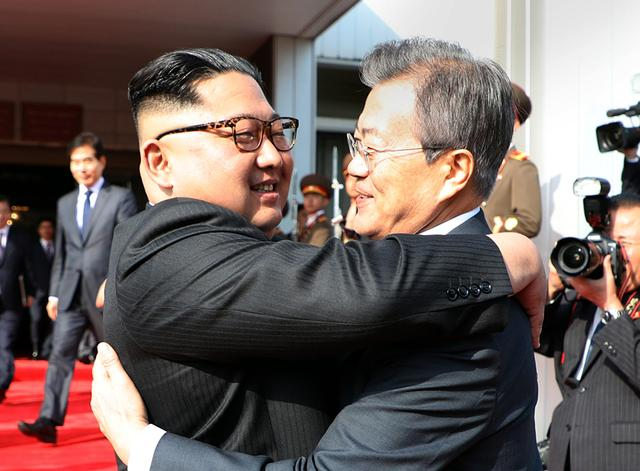
  CCTV News:On September 18th, the third meeting between DPRK and ROK leaders this year kicked off as scheduled. "Kim Jong-un suddenly appeared at the airport to meet Moon Jae in", "Kim Jong-un and Moon Jae in paraded in the streets of Pyongyang", "Kim Jong-un and Moon Jae in met at the headquarters of the Workers’ Party of Korea", "Meeting for three days and two nights, followed by Korean business giants" … … Judging from the news publicly reported at present, the "Jinwenhui" North Korea has once again become the focus of international public opinion with a series of rare courtesies, and wave after wave of heavy news has attracted much attention.

  Rare! North Korea’s high-level courtesy releases the greatest sincerity

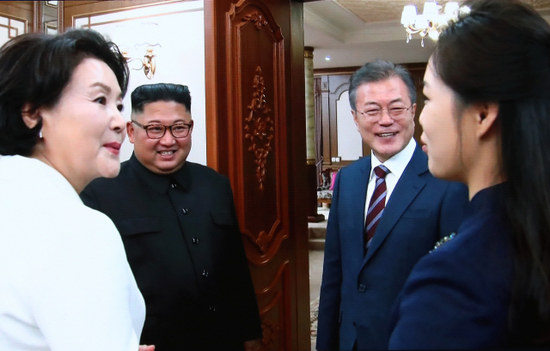
  On the morning of 18th, South Korean President Moon Jae in and his wife arrived in pyongyang sunan international airport by special plane, and North Korean leader Kim Jong-un and his wife Li Xuezhu personally greeted them. According to South Korean media reports, Kim Jong-un suddenly went to meet him without prior notice, giving people a surprise.

  At the welcoming scene, the DPRK broke the routine and fired a 21-gun salute; Thousands of people from all walks of life in North Korea are holding the North Korean flag and the Peninsula flag at the airport to prepare for the Korean delegation; In addition, there is a banner with white characters on a blue background that attracts people’s attention. It reads: "Warmly welcome President Moon Jae in to visit Pyongyang". This time, the North Korean side deliberately gave up the traditional white characters on a red background and chose blue as a symbol of Moon Jae in and the South Korean ruling Common Democratic Party. The implication is self-evident.

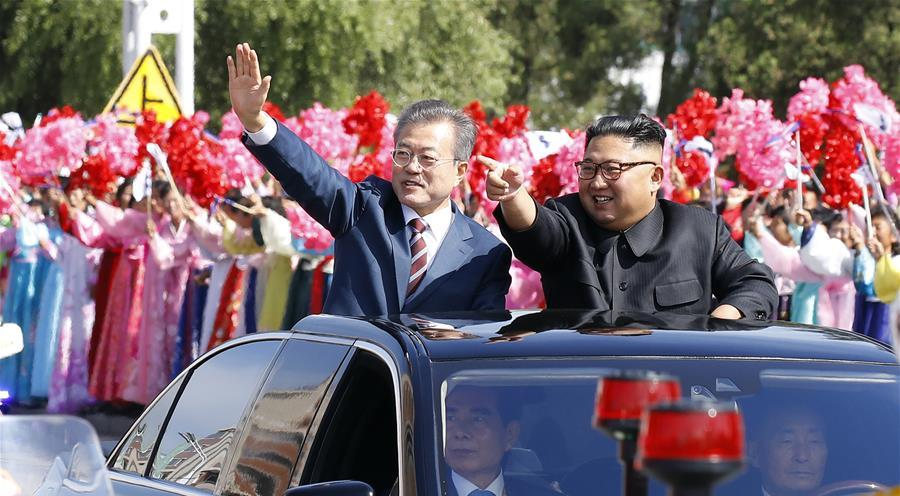
  On the way to the Baiyuan State Guesthouse in North Korea, North Korea also held a car parade for Moon Jae in. According to live footage, the two leaders sat in a black convertible Mercedes-Benz, smiling and waving at the cheers of Pyongyang people. On both sides of the street, many Koreans dressed in bright traditional costumes, singing and waving red flowers lined the streets to welcome Moon Jae in’s visit. As a result, Moon Jae in became the first South Korean leader to have a car parade in North Korea.

  After arriving at the hotel, Mr. and Mrs. Kim Jong-un enthusiastically led Mr. and Mrs. Moon Jae in into the State Guesthouse, and cancelled the welcome luncheon to give Mr. and Mrs. Moon Jae in enough rest time. When introducing the hotel environment to Moon Jae in, Kim Jong-un said modestly: "Although our conditions are not high, we will do our best to receive you, and I hope you can accept our sincerity."

  On the afternoon of 18th, Kim Jong-un set the meeting place in the Central Committee Building of the Workers’ Party of Korea, and Moon Jae in became the first South Korean leader to enter the headquarters of the Workers’ Party of Korea. Earlier, some Korean media reported that during Kim Jong Il’s administration, the headquarters of the Labor Party was called "the head organ of the revolution" and was rarely open to outsiders. Earlier meetings between Kim Jong Il and former South Korean Presidents Kim Dae-jung and Roh Moo-hyun were also held in Baihua State Guesthouse and other places.

  In addition to North Korea attaching great importance to Moon Jae in’s visit, South Korea has also made adequate preparations for this visit to Moon Jae in. In the list of Moon Jae in’s entourage to visit the DPRK, in addition to the heads of relevant state departments, there are also 50 special entourage, including Lee Jae-yong, vice president of Samsung Electronics, Cui Taiyuan, president of SK Group, Ju Guangmo, president of LG Group, and Jin Ronghuan, vice president of Hyundai Motor Group, and other Korean business giants.

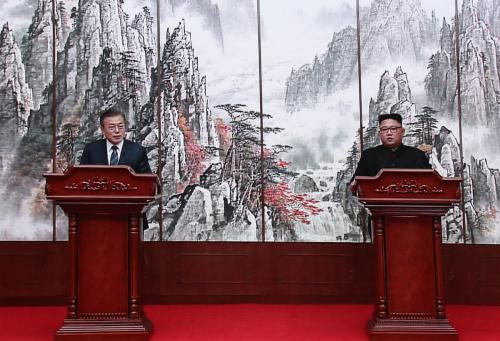
  In addition to a series of rare high-level hospitality, the results of this talk are also very fruitful. On the morning of the 19th, South Korean President Moon Jae in and North Korean leader Kim Jong-un signed the Pyongyang Joint Declaration in September, and announced to the world the willingness of the two Koreas to eliminate the risk of war, jointly bid for the Summer Olympic Games and reconnect the cross-border railway. Moon Jae in also said that he invited Kim Jong-un to visit Seoul. Kim Jong-un responded that he would visit Seoul soon.

  On the issue of "denuclearization", the DPRK and the ROK reached an agreement for the first time, unanimously agreeing to realize the denuclearization of the peninsula, eliminate the risk of war and jointly build a nuclear-free territory.

  Three-way handshake in six months! These changes have taken place in the situation on the Korean peninsula.

  Since the first "Jinwenhui" in April this year, the two sides have frequently interacted in many fields, and many "firsts" have been written into the history of exchanges between the two countries.

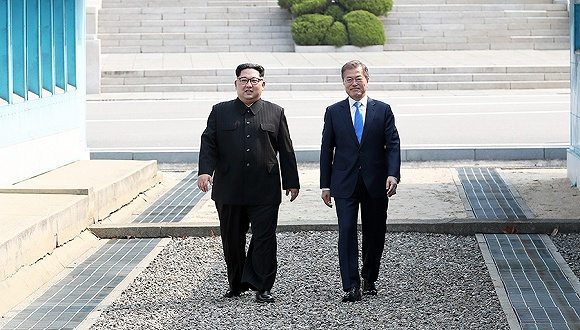
  On April 27th this year, Moon Jae in and Kim Jong-un met for the first time in Panmunjom, and jointly signed the Panmunjom Declaration, confirming the common goal of denuclearizing the peninsula by completely abandoning its nuclear weapons, and striving to declare the end of the state of war and realize the transformation of the armistice mechanism during the year. Kim Jong-un became the first North Korean leader to cross the military demarcation line and set foot on South Korean soil since the armistice of the Korean War.

  As "the first practical measure in the process of mutual cooperation", at 23: 30 local time on May 4, North Korea moved Pyongyang time forward by 30 minutes, and the DPRK and the ROK unified the standard time.

  While non-governmental exchanges are heating up, the ROK and the DPRK have gradually opened up the situation in easing the tension in military relations. On May 4th, the Korean-Korean border propaganda broadcast was officially "laid off", which became the first clause successfully implemented in the Panmunjom Declaration.

  One month later, the second summit meeting between the ROK and the DPRK was held in the context of the cancellation of the summit meeting between the US President and the DPRK. The interaction between the DPRK and the ROK is more frequent: the Asian Games joined hands to enter the venue, the reunion of separated families was restarted, the Fengxili nuclear test site was demolished, and the liaison office between the DPRK and the ROK was unveiled & HELIP; … The situation on the Korean peninsula is gradually easing.

  On June 14th, the ROK and the DPRK resumed high-level military talks after 10 years and 6 months. Less than two weeks later, the two sides held a working meeting at the university level, which promoted the completion of the repair of the military communication line on the west coast and promoted peace in the western waters of the peninsula. After that, the two sides held several military work talks to discuss topics such as the pilot evacuation of outposts in the demilitarized zone and the joint excavation of the remains of soldiers killed in the Korean War, so as to create a warm atmosphere for the third summit meeting.

  From the "ice-breaking meeting" in Peace House to the "lightning meeting" in Unification Pavilion to the third meeting between the DPRK and the ROK leaders in Pyongyang, the DPRK-ROK relations are heating up. The DPRK’s series of "big moves" are full of sincerity, and the situation on the peninsula is gradually easing. Who will be the biggest winner? How will the situation on the peninsula develop? Will there be no more war? Let’s wait and see! (Text/Cheng Xiang)

The measures to promote the construction of barrier-free environment and the aging of public facilities and transform the city to facilitate and benefit the people were well received.

Where is the temperature of a city?

The blind road on the sidewalk is gradually improving, the toilets for the elderly in bank outlets, the newly installed handrails in elevators and steps in old communities … Some seemingly insignificant changes in life have facilitated the daily life of the disabled and the elderly, and also made the city more friendly and livable.

This year’s "Government Work Report" proposes to promote the construction of barrier-free environment and the aging transformation of public facilities. In recent years, what progress has been made in China’s related work, what changes have been brought to people’s lives in various places, and what should be done next? The reporter conducted an interview.

Let people with disabilities travel more smoothly

Reduce the "breakpoint" of the blind road and the height difference of the kerb ramp.

When visually impaired people travel daily, obstacles will always appear inadvertently: it may be a raised step at the intersection, a manhole cover above the ground, or a discontinuous steep slope. In the capital Beijing, these "blocking points" in the past are gradually decreasing.

Shi Jing, a visually impaired person who lives in Fahua Nanli Community, Dongcheng District, Beijing, is 54 years old. After graduating from the school for the blind in 1990s, he became a masseur for the blind. Over the years, traveling back and forth between home and activity centers for the disabled day after day, Shi Jing measured the pace of barrier-free construction of roads in Beijing with a blind stick.

"Travel has to go through three levels, walk on the trail, cross the road and find the station." Shi Jing said that in the past, blind roads were not perfect in many places, so they had to knock on the road teeth and often went astray. Nowadays, leaving the community and turning into the trail, a large area of warning blind roads are laid; At the junction of the road and the trail, the steps were changed into gentle slopes; Around the bus stop, there is also a circle of blind roads, which is very practical.

Behind the convenience of visually impaired people, it is inseparable from the efforts and efforts of relevant departments. Jing Lubo, the relevant person in charge of the Urban Road Management Office of the Beijing Municipal Commission of Communications, told the reporter that since the implementation of the special action on barrier-free environment construction in Beijing in 2019, the city has managed more than 26,000 blind road problems, more than 6,500 crosswalk curb ramps have been sloped, and 35 pedestrian overpasses and underground passages have been transformed, achieving the basic "no breakpoint" for blind roads and "zero height difference" for curb ramps.

In order to create a barrier-free environment, the relevant departments have carefully crafted-

Turn a curve into a straight one. There are many manhole covers on some trails. In the past, blind roads were built around manhole covers. Although obstacles were avoided, it was not convenient enough. After many visits and listening to users’ needs and suggestions, the transportation department began to transform: first, "go to the height difference" and sink the raised manhole cover to the ground as much as possible; Then "bend to straight", change the traveling blind road located on both sides of the manhole cover into the prompting blind road for going straight, which not only reminds the visually impaired, but also allows them to take fewer detours.

Turn emergency into slow. According to the barrier-free design code, a gentle slope with a slope of about 8 degrees should be set at the interface between the road and the trail. However, many bus stops located on the isolation belt are small in area, which makes it difficult to slope in both directions. The design team made efforts to "embroider" the gentle slope from horizontal to vertical, and added handrails, which not only made the ramp gentle enough, but also made the space be effectively used.

For many cities, promoting barrier-free environment construction has become a "required question". In Beijing, a megacity with a population of over 20 million and an urban road mileage of over 8,400 kilometers, every "micro-renovation" tests the wisdom of managers.

At the 9: 00 am rush hour, at the intersection of Haidian District, Zhongguancun East Road and Zhichun Road in Beijing, people and cars passed by, but they were orderly. "Such a scene was unimaginable two years ago." Pointing to the auxiliary road separated from the main road of Zhichun Road by the green belt, Yang Yang, chief of the maintenance management section of Beijing Urban Road Maintenance Management Center, told the reporter that the auxiliary road originally had both motor vehicle lanes and non-motor vehicle lanes, and there was no room for footpaths, not to mention blind roads. During peak hours, people and vehicles were mixed, and the traffic was not smooth and pedestrians were inconvenient.

How to solve the problem? Through long-term monitoring and analysis of the traffic situation at the intersection, the optimal solution soon emerged: remove the motor vehicle lane on the auxiliary road, merge the right lane into the main road, and build new trails and blind roads at the same time. After the implementation of this plan, the traffic is smoother and the satisfaction of all parties is high.

"The construction of urban barrier-free environment is endless, and it is impossible to do it overnight." For more than 10 years, Yang Yang has participated in and witnessed the changes of barrier-free facilities in Beijing from scratch and from excellent to excellent. "Barrier-free construction is to make every link of road traffic smoother and safer, so that more people can feel the convenience of travel. In the future, we will combine the changes in roads and surrounding public facilities, sort out and adjust roads one by one, and strengthen the daily inspection and management of barrier-free facilities. "

In early spring, Shi Jing often takes his apprentices for an outing in Beijing. "Sometimes the important thing is not that I have to go to this building, but that I can go to this building myself." Shi Jing likes this sentence said by famous writer Shi Tiesheng very much. "In recent years, it has become more and more convenient for visually impaired people to go out to work. Even if it is difficult for us to see the city with our own eyes, we can really feel her kindness and warmth to us from the bottom of our hearts. "

Make it easier for the elderly to do things.

Add an "elderly area" offline and develop a "caring model" online.

China has the largest elderly population in the world and one of the fastest aging countries in the world. How to actively respond to the aging population and make the city more friendly to the elderly? It is imperative to adapt to aging in a wider range and at a higher level.

Early in the morning, Dai Qiulan, a 71-year-old Nanjing citizen, walked into the lobby of Nanjing Municipal Affairs Service Center. She felt a little weak: she wanted to apply for a preferential card for the elderly, but the words on the self-service machine could not be read clearly. Later, under the guidance of the staff, the doubts suddenly disappeared.

It turns out that the homepage of the self-service machine is specially set up with the "elderly area". When you click it gently, the font becomes larger and the color is clear, which saves you energy. In less than 10 minutes, Dai Qiulan completed the application process and quickly got the documents.

"Convenience service wants to facilitate the people, and you have to wait for the elderly." Du Zhongyu, deputy director of the Information Technology Department of Nanjing Municipal Service Management Office, said that in recent years, Nanjing has steadily promoted the aging transformation of public service institutions-

As soon as the elderly enter the hall, they will be guided by a special person and accompanied throughout the process; Set up the "elderly priority" window, equipped with special seats for the elderly; In the self-service machine and online service network, the "elderly area" will be opened simultaneously, which will be related to more than 50 high-frequency matters handled by the elderly, such as basic pension personal account inquiry and citizen card replacement; Open the Nanjing government service network, social security, provident fund, medical care and other convenient services are lined up, just click "barrier-free browsing" and you can switch to "care mode" in one second.

Intimate service won the praise of Dai Qiulan. According to statistics, after the aging transformation of government services in Nanjing in 2021, the number of elderly people’s offices increased by 67% year-on-year, and the satisfaction rate increased from 99.1% to 99.5%.

Praise is hard to come by. Aging renovation of public places is a systematic project, which requires both more manpower and more investment.

"Every old man needs special guidance when he enters the hall. After calculation, the service personnel gap is about 30%. " Du Zhongyan introduced that the relevant departments mobilized everyone’s enthusiasm to take more posts and take the initiative to make up the position through party member’s leadership and evaluation, and the shortage of personnel was effectively alleviated.

Funds can’t be absent. The number of old-age items is lower than that of ordinary items, and the cost of aging renovation and upgrading is hardly proportional to the number of users. "Suitable for aging transformation, and more importantly, its social value." Du Zhongyu said that at present, the proportion of elderly people over 60 years old in Nanjing is close to 20% of the city’s permanent population. The aging transformation will not only benefit the present, but also play a long-term role.

"The aging transformation of urban public space can not only better meet the needs of the elderly, but also benefit the long-term economic development." Wang Yu, director of the Laboratory of Building for the Aged in China Institute of Architectural Design and Research, believes that during the 14th Five-Year Plan period, the growth rate of the population over 60 in China will obviously exceed that during the 13th Five-Year Plan period. According to the characteristics of the elderly, finely improving urban public facilities will effectively enhance social vitality and further stimulate the development of the silver-haired economy.

Make community pension more comfortable.

Hardware space is perfect, software management is improved, and supporting facilities are optimized.

At present, most elderly people in China choose to live at home for the aged. Community is the carrier and foundation of home-based care for the aged, and it is also the focus of aging transformation.

Spring in Hangzhou in March is just right. In the Qian Jing community in Shangcheng District, Zhu Shuangmei, a retired old man, and his wife had just had lunch from the elderly canteen, and they went to the elderly activity center dozens of meters away to rehearse new songs with the old sisters of the choir. "Community pension, quite comfortable!" Zhu Shuangmei said.

Regular and simple old-age canteen, well-equipped health consultation room and brand-new and exquisite activity center, through the introduction of third-party institutions, Baimi Street across Jingfang East District has a one-stop community pension service integrating life care, culture and entertainment, and medical care.

Two years ago, the 100-meter street was another look. Jingfang East District was built in the 1990s. After the rise of commercial streets, it was convenient for residents to buy food and eat at home, but it also caused cross-flow of sewage and dirty environment.

In September, 2020, with the continuous promotion of the comprehensive renovation and upgrading of the old residential areas in Shangcheng District, the community in Qian Jing ushered in an opportunity of "changing its old look into a new one". In order to do a good job and make the work in the hearts of the masses, the community specially held a forum for soliciting opinions, asking everyone to brainstorm and discuss the plan.

"At present, the number of elderly people over the age of 60 in the community has exceeded one third, and the voice of community public pension services is very high. Building an elderly canteen can not only meet the dining needs of the elderly, but also be open to all community residents, which can maximize the use of existing space. " At the meeting, Zhu Hongying, secretary of the community party committee, listed the community development needs one by one. In the end, the aging-adaptive transformation scheme has been recognized by most people.

Qian Jing community is a microcosm of the aging transformation of old communities. "Today, meeting the needs of the elderly in the community with high quality has become a key task in the transformation of old communities." Yan Gang, secretary of the Party Committee of Hangzhou Urban and Rural Construction Management Service Center, said that Hangzhou has systematically optimized supporting facilities for the elderly in the community through measures such as tapping the potential of hardware space, multi-subject collaboration and software management upgrading, and has used market-oriented mechanisms and actively introduced social capital to stimulate the sustainable motivation of upgrading community services, so that more and more elderly people can enjoy more professional and more yuan-based aged care services in the community.

According to reports, since 2019, Hangzhou has completed the renovation of 714 communities, benefiting nearly 360,000 residents. The city has added 121,000 square meters of service facilities such as old-age care and cultural activities, including about 22,700 square meters of old-age service places, and added 3,851 barrier-free and aging-friendly facilities. From a national perspective, from 2019 to 2021, the country started to renovate 115,000 old urban communities, benefiting more than 20 million households; In the process of transformation in various places, a total of 51,000 elevators were installed, and more than 30,000 community service facilities such as old-age care were added.

In the living room of Zhu Hongying’s family, the discussion about the aging transformation of the community continues. "The old-age day care center mentioned last time, we are working on the transformation, and we will focus on it this year." Zhu Hongying tells everyone. "This is good! When you get together, you are not alone. " Community residents nodded in praise.

At the national level, the blueprint for promoting barrier-free environment construction and aging transformation has been drawn. The 14th Five-Year Plan for Barrier-free Environment Construction issued at the end of last year clearly states that by 2025, the legal guarantee mechanism for barrier-free environment construction will be more perfect, the barrier-free basic public service system will be more complete, the information barrier-free service will be deeply applied, the barrier-free humanistic environment will be continuously optimized, the systematic, complete and inclusive level of barrier-free facilities in urban and rural areas will be significantly improved, 1.1 million families with severe difficulties and disabilities will be supported to carry out barrier-free transformation, and barrier-free facilities with complete facilities, perfect functions, smooth information and comfortable experience will be accelerated. (Reporter Han Xin Yao Xueqing Dou Yuyang)

The GDP ranking of 31 provinces in the first half of the year was released, and the growth rate of 23 provinces "outperformed" the whole country (table)

  China Economic Net, Beijing, August 25th (Reporter Yang Miao) With the release of GDP in the first half of the country, various provinces and cities in China have successively released the "report cards" of GDP in the first half of 2016. According to the statistics of China Economic Net from official website of the National Bureau of Statistics, at present, all 31 provinces and cities have published their GDP data for the first half of 2016.

  The data shows that the GDP growth rate of 23 provinces in the first half of the year outperformed the national GDP growth rate of 6.7%. The growth rates of Beijing, Shanghai and Jilin were the same as the national growth rate, and only Yunnan, Hebei, Heilongjiang, Shanxi and Liaoning were lower than the national growth rate.

  China Economic Net found that the situation in the three northeastern provinces improved in the second quarter, and the GDP growth rate in Jilin was equal to the national level. Although the GDP growth rate in Liaoning Province was still negative, the growth rate increased.

  China’s GDP increased by 6.7% in the first half of the year.

  The national economy is generally stable.

  The National Bureau of Statistics recently released the national economic data for the first half of the year. It is understood that the GDP in the first half of the year was 34,063.7 billion yuan, with a year-on-year increase of 6.7%, and the growth in the second quarter was 6.7%, which was the same as that in the first quarter. On the whole, the national economy has maintained a generally stable, steady and progressive development trend.

  Among them, the added value of the primary industry was 2,209.7 billion yuan, a year-on-year increase of 3.1%; The added value of the secondary industry was 13,425 billion yuan, up by 6.1%; The added value of the tertiary industry was 18,429 billion yuan, up by 7.5%.

  According to experts’ analysis, it is really hard-won for China’s economy to achieve 6.7% growth in the context of the continued slowdown of world economic growth.

  Of the 12 western provinces, only Yunnan’s growth rate has not exceeded the national level.

  Chongqing’s growth rate for 10 consecutive quarters is "among the best"

  It can be found from the table that the year-on-year GDP growth data of 31 provinces and cities in the first half of 2016 shows that Tibet, Chongqing and Guizhou lead the country in this indicator, with GDP growth rates of 10.6%, 10.6% and 10.5% respectively. The top three were all taken by the western provinces. On the whole, except Yunnan, the other 12 western provinces all exceeded the growth rate of 6.7% in the first quarter of the country, and the economic development momentum of the western provinces continued to increase.

  The transcripts of Chongqing and Guizhou in the first half of the year were still bright, and the growth rate remained in the top three, with an increase of more than 10%.

  According to China Economic Net, Chongqing has maintained its economic growth rate in the forefront of the country for ten quarters under the great downward pressure. Zhang Fumin, deputy director and spokesman of Chongqing Municipal Bureau of Statistics, said that it is not easy for Chongqing to maintain such a high growth trend. He believed that the rapid development of five functional regions, industrial transformation and upgrading, structural adjustment, accelerated formation of new impetus and new economy worked together to support the beautiful economic landscape of Chongqing in the first half of the year.

  In addition, Guizhou’s performance has been excellent in recent years. Luo Guanghua, a professor at the Party School of Guizhou Provincial Party Committee, pointed out that Guizhou’s rapid economic development is mainly due to the small total GDP, which is relatively fast.

  The GDP growth rate of the eight provinces in the first half of the year declined compared with the first quarter.

  Hainan has the largest decline.

  According to the statistics of China Economic Net, as can be seen from the table, compared with the GDP growth rate in the first quarter, the GDP growth rate of Chongqing, Tibet, Jiangsu, Hainan, Henan, Shaanxi, Inner Mongolia and Beijing declined in the first half of the year. The GDP growth rate of Jiangxi, Anhui, Fujian, Qinghai, Shandong, Shanghai and Yunnan was the same as that of the first quarter. The GDP growth rate of other provinces has increased compared with the first quarter.

  Among them, Ningxia, Xinjiang and Gansu increased significantly compared with the first quarter. Xinjiang’s GDP increased by 8.0% last year, 1.1 percentage points faster than the 6.9 in the first quarter.

  Wang Yue, deputy director of the Statistics Bureau of Xinjiang Uygur Autonomous Region, pointed out at the press conference that under the guidance of a series of steady growth measures, the steady growth trend of Xinjiang’s economy has not changed, the pace of structural adjustment, transformation and upgrading is gradually accelerating, and the quality and efficiency of economic growth are gradually improving.

  Compared with the first quarter, Hainan’s GDP growth rate in the first half of the year dropped significantly by 1.6 percentage points.

  Jilin’s GDP in the first half of the year "tied" the national growth rate

  The economic development of the three northeastern provinces has "recovered"

  China’s economic development has entered a new normal, facing structural adjustment and transformation. De-capacity has been ranked among the "five major tasks" of economic work in 2016, and supply measurement reform is a high-frequency word this year.

  According to China Economic Net, in the ranking of GDP growth rate of 31 provinces in China in 2015, the economic growth rate of 5 provinces was lower than 6.9%, including Liaoning, Shanxi, Heilongjiang, Jilin and Hebei, among which Liaoning ranked first from the bottom with a growth rate of 3%. In the first quarter of 2016, these five provinces once again ranked the fifth after the GDP growth rate, and Liaoning experienced negative growth for the first time.

  From the data of the first half of the year, the three northeastern provinces are divided, and the overall situation of Jilin is obviously better than that of Liaoning and Heilongjiang. The GDP growth rate in the first half of the year tied the national level, which is the first time since 2014, which strongly responded to the argument of singing the decline of the Northeast economy.

  Although Heilongjiang Province is still ranked last, it has maintained a steady upward trend compared with the first quarter. Although Liaoning Province continued the negative growth trend in the first quarter, the data also picked up.

  Yao Jingyuan, a special researcher in the State Council Counselor’s Office, once said that the three northeastern provinces have the foundation and conditions, and the economic growth rate can pick up. Taking the manufacturing industry as an example, the northeast has advantages that many provinces do not have.

  In order to revitalize the economies of the three northeastern provinces, according to China Economic Net, the National Development and Reform Commission recently issued the "Three-year Rolling Implementation Plan for Promoting the Revitalization of Old Industrial Bases in Northeast China (2016-2018)", focusing on four core tasks: improving institutional mechanisms, promoting structural adjustment, encouraging innovation and entrepreneurship, and ensuring and improving people’s livelihood. In addition, the implementation plan also clearly speeds up the improvement of the government management system, deepens the reform of state-owned enterprises, and promotes the development of private economy, including formulating and organizing the implementation of the reform plan of state-owned enterprises in Northeast China, and reorganizing and forming a number of state-owned capital investment companies and operating companies in Northeast China.

  The GDP growth rate of eastern provinces is not as fast as that of western provinces.

  Policy inclination promotes economic development in western China

  Judging from the numerical changes of GDP of 31 provinces and cities in the first quarter, the top three are all eastern coastal areas, namely Guangdong, Jiangsu and Shandong. The total GDP in the first half of the year was 3,735.759 billion yuan, 3,653.173 billion yuan and 3,168.829 billion yuan, and the three provinces continued to sit firmly in the "trillion club".

  China Economic Net found that although Guangdong and Shandong ranked in the top three in terms of total GDP, Guangdong ranked 19th and Shandong ranked 20th in terms of GDP growth rate of 31 provinces and cities in the first half of the year, and their GDP growth rates were not very high, at 7.4% and 7.3%, far less than those of many western provinces.

  China Economic Net understands that the eastern provinces of China are developing export-oriented economies, and the economic growth rate will inevitably be adjusted due to the global economic downturn. Compared with the eastern region, the central and western regions have undertaken a number of industrial transfers in recent years, and they have been tilted by national policies. These factors will promote the economic development of the western region.