Japan’s new emperor meets the people for the first time, and the Japanese right wing is at the head of the team.
[Global Times-Special correspondent of the World Wide Web in Japan Jiang Feng Lv Peng] On May 4th, at the invitation of the Japanese Palace Office, a reporter from Global Times participated in the first meeting with the people after Crown Prince Naruhito succeeded to the throne on May 1st. This activity is called "general congratulations" in Japanese. The so-called "average" of course means that ordinary people can enter the palace as long as they line up outside the palace early; The so-called "joining congratulations" does not mean "attending congratulations", but "paying homage to congratulations". The reporter knows that readers are definitely not unfamiliar with the term "paying homage". However, it is not the "society" but the "people" who pay homage this time — — The new emperor who just succeeded to the throne.

The activity is scheduled to start at 10 am. The report room of the General Affairs Section of the Palace Office requires invited reporters to report to the main gate of the palace from 7: 30 to 8: 15. So, the reporter had to get up early. Finally, he changed to the East-West train and got off at Zhuqiao Station. After coming to the ground from the A1 exit, he walked along the Palace and passed the Platycodon Gate, then he went to Ganmen.

While waiting in line, the reporter kept looking at the dry door. To tell the truth, it is no wonder that the Japanese call the "imperial palace" the "imperial residence". Its gate is indeed a bit like the gate of a local tyrant’s house, which is different from the palace in China in the Ming and Qing Dynasties — — Today’s gate of the Forbidden City is really incomparable. This is the northwest gate of the Japanese Imperial Palace and one of the 11 gates of the Imperial Palace.
After going through the registration formalities at Ganmen, the reporter received a yellow "report" card, and after strict equipment security inspection and personal inspection, the reporter entered the palace from Ganmen. Along the way, I passed Ganhao, Xijiuqiao, Lianchi and Daoguan, and arrived at the entrance of the Palace Hall. For the Palace Hall — — This department in charge of palace affairs, whether it is the Japanese royal family or senior Japanese officials, can pour out a lot of bitter water, but after all, it is the "in-charge" and no one can do anything about it. All the "photographers" and "writers" gathered here, waiting for the staff in the report room of the General Affairs Section of the Palace Hall to call the roll one by one, and some were given a purple ribbon and some were given a red ribbon, thus determining the interview position where the reporter could stand.

The reporter learned that this "general congratulations" was originally scheduled to be held in October 2019. However, considering the unprecedented large-scale "ten consecutive holidays" brought about by the succession of the new emperor, it was easier for ordinary people to come out for activities during this period, so it was held in advance. Originally, it was decided to be held the day after the new emperor ascended the throne on May 1st, but considering that the new queen Masako suffered from depression for a long time, as long as she participated in official activities continuously, she would get sick, so it was adjusted to May 4th. From here, we can see the increasing humanization of the Japanese imperial palace.
Soon, the reporter entered the square with an area of 4,500 ping — — East court of the palace On the front of it is the longest palace in the palace — — Changhe Hall has a total length of 160 meters, of which the corridor is 100 meters long, and there are six balconies wrapped in bullet-proof glass windows in the middle. Every year on January 2nd of the New Year and the birthday of the emperor, the Japanese emperor and the royal family will hold activities here to accept the "general congratulations" of the people.

The reporter noticed that there were three helicopters hovering over the "East Palace", and many "Palace Police" were pulling ropes, marking lines and running constantly. There was a tense atmosphere at the scene. Suddenly, it came out on the radio that because the people waiting outside the palace had lined up, they decided to open the palace door 20 minutes in advance. Perhaps this is another manifestation of the "humanization" of the palace.
At about 9: 40, the crowd of "general participants" began to enter the "Palace East Court" square. Interestingly, the first row of the team is a policeman arm in arm, and in front of the policeman is a policeman and a person who seems to be the head of a Japanese right-wing group. Behind the police, red and purple were held high and the words "Long live His Majesty the Emperor!" , "I wish you peace" and so on. One of the flags reads "The Meeting of the Rise of the Grass Mang", which is a famous right-wing nationalist group in Japan. In 2015, the drivers’ licenses of members of the association were revoked by Japanese police for threatening former Japanese Prime Minister Yukio Hatoyama who gave a speech entitled "Exploring the Road of Friendship in Sino-Japanese Relations" at Meiji University.
Right-wing group members were at the forefront of the first meeting with Japanese nationals after the new Japanese emperor succeeded to the throne. This landscape shows the undercurrent of Japanese society. The reporter also saw some Japanese standing in front of the mayor and the temple, with the words "respect for God and the emperor" and "gratitude" written on their collars. When the new emperor delivered a speech, these people couldn’t help shouting "Long live His Majesty the Emperor" and then enthusiastically sang the Japanese national anthem "Jundai".

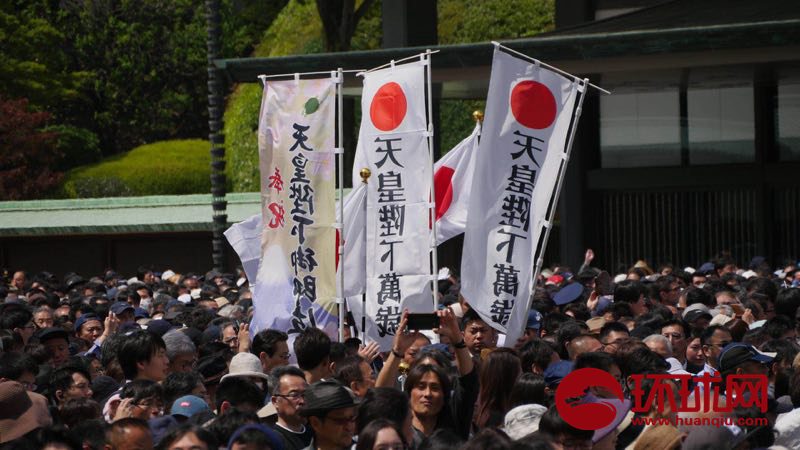

According to official figures, the number of people who came to participate in the "general congratulations" activities on this day reached 141,130. In November 1990, the first "general celebration" after Emperor Heisei succeeded to the throne was attended by only 109,800 people. It seems that the number is a little too much. However, it should also be noted that when Emperor Heisei held his last "general congratulations" before his abdication in January 2019, the number of people present was 154,800. In contrast, the number of people arriving this time is a little less.
The reporter noticed a report in Tokyo News on May 4th entitled "Carry forward the national prestige and aim at constitutional amendment", which pointed out that Japan is now in danger of "making political use of the emperor and carrying forward the national prestige, with the aim of promoting the revision of the Constitution."
Obviously, with the succession of the new Japanese emperor and the entry of Japan into the era of "making peace", Japan is facing another crossroads.