At the beginning of July, the self-driving tour season of the eastern route in northern Xinjiang started. The picture shows the starting group taking pictures in Jiangbulak Scenic Area. Photo by Han Rong

In midsummer, Sailimu Lake in Xinjiang is picturesque. Tourists enjoy the pleasant scenery by the lake. Economic Daily reporter Ma Chengzhong photo

On July 19th, at the 7th Dao Lang Food Folk Culture Tourism Festival in awat, the local souvenirs were featured with distinctive features and were well received. Economic Daily reporter Ma Chengzhong photo
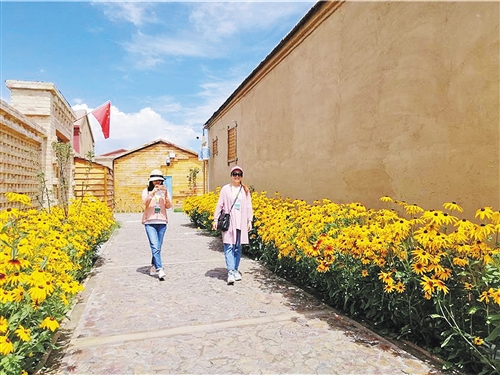
The "Tianshan Cultural Tourism Season" in Tekes County, Xinjiang recently kicked off. The picture shows tourists visiting the folk-custom pedestrian street in the county. Economic Daily reporter Qiao Wenhui photo
Homogenization of tourism resources; Seasonal imbalance, obvious in light peak season; The journey time is long and the play time is short. Xinjiang tourism has faced three difficult problems. Nowadays, tourism in Xinjiang continues to be hot. In 2018, the number of tourists exceeded 150 million, an increase of more than 40%, and various indicators showed a "blowout" trend. Why does Xinjiang tourism "butterfly change" rapidly? How is the new kinetic energy cultivated? The reporter made an interview and investigation on Xinjiang.
The grassland is vast, the snow peaks are magnificent, the rivers are rushing, the sea of flowers is endless, the desert is vast, and the Gobi is boundless … … Colorful Xinjiang is desirable. In midsummer, walking north and south of Tianshan Mountain is like being in Traveling in a pictorial world.
Since last year, Xinjiang’s tourism has continued to be hot, and various indicators have shown a "blowout" trend. In 2018, the number of tourists exceeded 150 million, an increase of more than 40%, accelerating the transition from a large tourism resource area to a strong tourism economy area. Sakel, chairman of the autonomous region, said that the strategy of rejuvenating Xinjiang through tourism should be fully implemented to create a growth pole for economic development, and the number of domestic and foreign tourists and the total tourism revenue should be increased by more than 40% this year.
Why does Xinjiang tourism "butterfly change" rapidly? How is the new kinetic energy cultivated? The reporter learned in the interview and investigation that the key lies in Xinjiang’s continuous efforts to solve three problems, namely, the homogenization of tourism resources; Seasonal imbalance, obvious in light peak season; The journey time is long and the play time is short. By answering these three questions well, the tourism industry strives to move towards the growth pole of regional economic development.
How to break the homogeneous competition
Xinjiang is rich in tourism resources, but there are also some shortcomings with similar scenic spots and obvious homogenization. In this regard, all parts of the region are actively exploring, among which cracking homogenization with tourism branding has become an effective measure. Some experts said that by creating distinctive tourism brands and realizing differentiation and specialization, disorderly competition can be effectively avoided and a rich "tourism feast" can be cooked together.
This spring, many places in Xinjiang launched a "flower economy", and various "apricot blossom festivals" were held one after another. In order to highlight the characteristics, Tianshan Township, Yizhou District, Hami City mainly promotes photography, folk customs and performances, and creates a tour route of "Xing Fu Ji+Ancient Customs online celebrity Long Street+Xing Yuan", so that tourists can experience the ancient customs and charm in an immersive way. By taking the road of differentiation, obvious results have been achieved.
"In the thin shadow of apricot blossoms, flute until dawn." Some tourists walk around Xinglin in Hanfu and recite ancient poems. "I have experienced a different kind of travel than before." Ma Shunxiang, a resident of Shanshan County who came here with his family to enjoy apricot blossoms, watch performances and taste delicious food, said: "There are apricot blossom festivals in many places around, and the style here is obviously different, which is fun and durable."
Like Yizhou District, Yingjisha County has taken a different approach. The county has 150,000 mu of almond trees competing to bloom. While focusing on apricot blossom tour, it also introduces traditional earthenware making experience to improve the "viscosity" of tourism projects. After enjoying the apricot blossom, some tourists went to the nearby "traditional earthenware making village" to make a souvenir for themselves under the guidance of earthenware artists.
It is a common practice to explore new selling points in traditional projects to promote tourism branding in Xinjiang. The "Fantastic Night of the Museum" held in Turpan is held every Saturday night in July and August. Visitors can listen to lectures, enjoy music and set up tents in the Giant Rhinoceros Fossil Hall for the night. Deng Yonghong, deputy director of Turpan Museum, said, "This activity aims to make cultural relics ‘ Live ’ Get up, let history speak, and let tourists understand history and culture in a unique experience. "
Due to the special geographical location and climatic conditions, rainbows appear frequently in summer in Zhaosu County, sometimes many times a day, and even there are double rainbows and three rainbows. The local meteorological department set up a team to provide rainbow forecast. Watching rainbows and starry sky has become a new tourist attraction besides traditional tourism projects such as flower watching and horse racing. He Jiaolong, deputy county magistrate, said that Zhaosu is building a new business card of "Rainbow Capital of China" and making great efforts to cultivate a "romantic economy".
The reporter learned from the Department of Culture and Tourism of Xinjiang Uygur Autonomous Region that from June to October this year, 390 cultural tourism activities will be carried out in the whole region. It is not difficult to find out that although there are many festival activities, all localities are trying to dig out "unique font" or "special font". Such as "ten thousand acres of Achnatherum splendens" maze fun adventure, rural open-air art festival, night tour cantaloupe garden and other activities are unique and attractive.
In addition, compared with previous years, the proportion of activities such as "tourism+culture", "tourism+events" and "tourism+popular science" is higher, such as sports tourism camping conference, sculpture exhibition at the foot of Tianshan Mountain, musical instrument culture tourism festival and so on. These activities extend and enrich the connotation of tourism, and will further promote the branding of Xinjiang tourism.
How to promote "Four Seasons Tourism"
In the past, the seasonality of tourism in Xinjiang was obvious. Most tourists concentrated in July to September, and the highest proportion of tourists received in these three months accounted for more than 90% of the whole year. Mo Wenling, a tour guide, told the reporter: "It turned out that in summer, I was busy in winter, and I worked for three or four months a year. Many tour guides faced unemployment as soon as autumn passed." How to Sing Tourism "Four Seasons Songs"? In the interview, the reporter learned that all parts of Xinjiang have made moves, mainly to lengthen the short board and do winter tourism articles.
Last year, the scenic spots in Xinjiang were "closed" in winter, and more than 300 tourism activities were held in various cities and prefectures to cultivate the ice and snow economy. Fuhai County plans tourism projects based on Lake Ulungu, and strives to "delay" the peak season and "shorten" the off-season. Through planning and construction, tourists can enjoy the lake, watch birds and see Yadan landform along the highway around the lake for more than 20 kilometers in spring and autumn. In summer, you can go to the Gold Coast Scenic Area to escape the heat and enjoy sand therapy. In winter, visitors can skate, catch in winter and experience car drift.
"Now, winter fishing has become a special tourism project in Fuhai, which has stimulated the development of winter tourism." Na Yan, director of Fuhai County Culture, Sports, Radio, Film and Tourism Bureau, said that during the winter and spring tourism season from November last year to March this year, the county received a total of 249,000 tourists, a year-on-year increase of 67%; The total tourism revenue was 2.1 billion yuan, up by 123%.
In the process of developing winter tourism, some traditional summer hot spots in Xinjiang focus on promoting supply-side structural reform and plan winter tourism projects one after another. Tianshan Tianchi Scenic Area has held ice and snow scenes year after year. At the end of last year, it joined hands with travel agencies to launch 7 theme activities and 14 online and offline activities to create "our Tianshan Mountain, our ice and snow journey"; At the beginning of the year, Kanas Scenic Area held a Snow Festival to tap the potential of winter tourism.
As the "birthplace of human skiing", Altay region insists on implanting folk culture into winter tourism, constantly enriching the connotation of winter tourism, promoting ancient fur skiing experience projects, organizing snow wrestling, snow horse racing and other events, so that tourists can experience rich folk culture while enjoying the snow. "By making tradition and modernity interact, folk customs and fashion blend, the momentum of winter tourism is released." Wang Junan, Deputy Commissioner of Altay Regional Administrative Office, said.
Integrating leisure vacation into tourism projects is also an important measure to develop winter tourism in Xinjiang. Winter tourism is seasonal, so it is particularly important to enrich the connotation of tourism products. In recent years, some prefectures and cities have vigorously developed leisure and holiday products such as winter hot spring health care and forest skiing. fukang city Wujiang Hot Spring City and Shawan County Hot Spring Tourism Resort have become more and more famous, which has enhanced the comprehensive benefits of local winter tourism.
Ice and snow are also Jinshan Yinshan. The development of winter tourism in Xinjiang is of great significance for implementing the new development concept, singing the "four seasons songs" of tourism in the whole region, deepening the implementation of poverty alleviation and promoting the income of farmers and herdsmen. According to statistics, from November last year to January this year, the whole region received more than 11 million domestic and foreign tourists, up more than 50% year-on-year.
The data shows that the potential of winter tourism in Xinjiang is being released, and a solid foundation has been laid for transforming "cold resources" into "hot economy". If we continue to exert our efforts and persist in vigorously developing winter tourism, the future will echo the traditional winter tourism hotspots such as Northeast China, and stretching the "other wing" of domestic winter tourism will form a domestic winter tourism industry pattern of "two wings Qi Fei".
How to solve the problem of "a brigade commander traveling short"
Xinjiang has a vast territory, and the Tianshan Mountains run through the middle, which leads to scattered scenic spots, long travel time for tourists and high tourism costs. How to solve the problem of "a brigade commander travels short"? The comprehensive policies of various cities and relevant departments in Xinjiang, starting with improving traffic conditions, make "the inner ring of Xinjiang, get in and out of Xinjiang quickly".
On the highway side, weave a "fast forward and slow travel" tourist transportation network. According to the plan, Xinjiang will build a road transport service network with Urumqi as the center, the New Eurasian Continental Bridge as the main axis, the Tarim Basin and Junggar Basin as the two wings, and the east is connected to the west, and the north and south are smooth, so as to realize regional coordination and convenient connection between the north and the south of Tianshan Mountain.
With the continuous extension and improvement of the railway, China Railway Urumqi Bureau Group Co., Ltd. has carefully cultivated the tourism brand of "Traveling in Xinjiang by Train". The bureau has designed 49 boutique tourist routes, adopting the mode of "overnight trains and day trips to scenic spots", and plans to open 100 special tourist trains this year.
The routes in Xinjiang are also densely woven into a network and gradually "ring up". In the past, Xinjiang’s route network was centered on Urumqi and basically radial. Nowadays, there are more choices for travel. Korla Airport is the aviation sub-hub airport in Xinjiang. Wang Wei, deputy general manager, told the reporter that the originating route of Korla has achieved full coverage in the regional regional feeder airports, and now it can fly directly to Aksu, Kuqa, Kanas and other places. On June 25th, the passenger throughput of the airport exceeded 1 million passengers, reaching this figure 45 days earlier than last year.
Based on solving the problem of "short travel", in addition to improving traffic conditions, various parts of Xinjiang have also strengthened mutual cooperation, set up a number of cross-regional tourism alliances, carried out mutual recommendation, resource interaction and market sharing among tourists, and strived to make "passers-by" become tourists and new tourists become overnight visitors to jointly cultivate the tourism market.
On June 24th, Urumqi City, Changji Hui Autonomous Prefecture, Turpan City, Shihezi City and Karamay City signed the Consensus on the Coordinated Development of Cultural Tourism Integration, proposing to integrate the superior resources of cultural tourism in the five cities, strengthen regional linkage, jointly plan the marketing plan of cultural tourism products, and create characteristic cultural tourism brands and boutique routes. On the same day, the activity of "100-day Tour to Tianshan Mountain and One Certificate to Benefit Five Places" was also launched. Residents of five places can enjoy 50% discount or free tickets in 100 scenic spots and cultural places with their ID cards within 100 days.
In this regard, Zhu Xinrong, director of Urumqi Culture and Tourism Bureau, said that the coordinated development of cultural tourism in the five places will promote the comprehensive integration of scenic spots in central Xinjiang led by Urumqi, and the cultural tourism resources in the five places will show greater attraction. "Starting from Urumqi, the original short-distance routes mainly include a one-day tour of Turpan and a one-day tour of Tianshan Tianchi. This time, it can be designed through integration and development ‘ Travel around ’ Will attract more tourists. " The person in charge of the domestic branch of CYTS Xinjiang International Travel Service Co., Ltd. said.
Guli Abu Limu, deputy director of the Xinjiang Department of Culture and Tourism, said that it has entered the tourist season, and the market is hot and orderly. Cities and prefectures all over the region have joined forces to sing the tourism brand "Xinjiang is a good place", breaking through administrative divisions and building regional tourism alliances, enriching the original single tourism products and further promoting the development of tourism in Xinjiang. Some people in the industry believe that the tourism cooperation alliance will help to build and cultivate regional brands, promote the formation of differentiated tourism brands, improve the "viscosity" of tourist areas, effectively solve the problem of "traveling long and short" and enhance the comprehensive benefits of tourism. (Economic Daily China Economic Net reporter Qiao Wenhui)