"Wenbo fever" drives China’s double holiday consumption fever
Xinhua News Agency, Beijing, October 9th (Reporter Luo Xin) Medals, badges, bus passes, commemorative porcelain and old photos … … When the athletes struggled in the Hangzhou Asian Games, the cultural relics carefully arranged in the exhibition hall outside the venue seemed to pull the audience back to decades and hundreds of years ago, telling the historical origins of China, the Asian Games and the Olympic Movement.
"On the eve of the Mid-Autumn National Day holiday, our museum is in Beijing and Hangzhou ‘ Shangxin ’ Ten sports and Olympic special exhibitions, many viewers come to visit the exhibitions and feel the charm of Chinese sports culture after watching the games. " Li Xiang, curator of Beijing Xiang Sports Museum, felt the heat of "cultural tourism" during this "Super Golden Week" holiday.
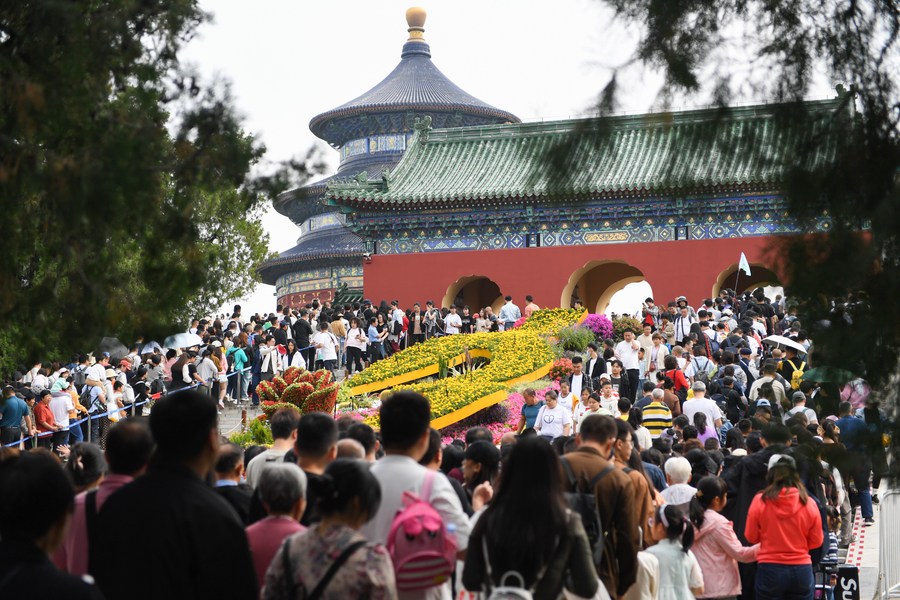
On October 2, tourists lined up in the Temple of Heaven Park to visit the Hall of Prayer for the New Year. Xinhua News Agency reporter Yan Huanzong photo
This year’s Mid-Autumn Festival coincides with the National Day and the Asian Games in Hangzhou. With the theme of reunion, patriotism and sports, major museums, art galleries and related cultural and art institutions have launched cultural and art activities and products that integrate performing arts, social education, intangible skills, digital technology and immersive experience, attracting people to choose to celebrate the festival during travel and driving the holiday consumption fever.
According to the data released by the Beijing Municipal Bureau of Cultural Relics, as of October 6, the city’s museums received about 2.206 million visitors, with an average daily reception of 276,000, an increase of 93% compared with the same period in 2022. The Palace Museum, Gongwangfu Museum of the Ministry of Culture and Tourism and China National Museum all received more than 10,000 visitors per day. A number of small and medium-sized characteristic museums such as Beijing Folk Museum and Laoshe Memorial Hall also performed brilliantly, and the number of visitors increased significantly compared with the same period.
During the "Double Festival" holiday, based on the basic display, museums in Beijing have launched 126 exhibitions and activities around the Mid-Autumn Festival and National Day, combined with their own characteristics. National Museum of China "Learn from the past and know the distance — — Exhibition of archaeological achievements in the new era ",the Palace Museum" Five continents and four seas — — ‘ Belt and Road ’ A number of fine cultural and cultural exhibitions such as the Cultural Relics and Archaeology Cooperation Exhibition presented a festive cultural feast for the audience.
After urban renewal, more and more cultural sites, cultural venues and cultural leisure blocks are open to the public with a better look, providing more beautiful new living spaces for urban tourism consumption.
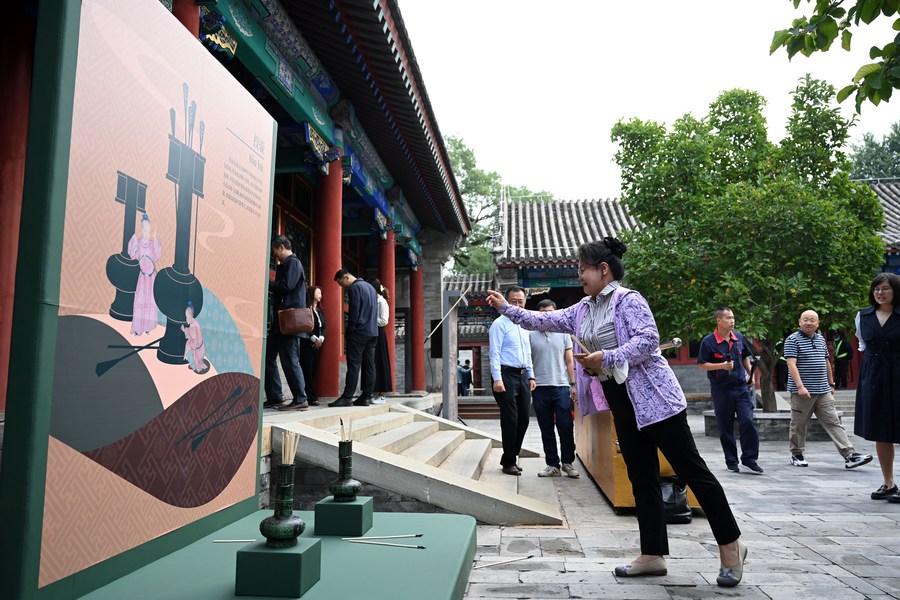
On September 25th, at an exhibition of Gongwangfu Museum in Beijing, the audience experienced throwing pots. Xinhua News Agency reporter Jin Liangkuai photo
Wandering in the beautiful landscape of the garden, feeling the culture of the Ming and Qing dynasties, and enjoying the traditional handicrafts in the ancient buildings … … In Daxing, Beijing, the Tuanhe Palace "One Park and Two Museums" (Tuanhe Palace Ruins Park, Nanhai Ziyuan Museum and Daxing District Museum), which was put into trial operation before the National Day holiday, has become a good place for many citizens to go by car and relax.
During the Mid-Autumn National Day holiday this year, long-distance and medium-distance tourism achieved a high growth, and "punching in" the cultural and cultural venues of tourist destinations and participating in cultural and cultural activities became popular choices. Chen Tao, head of Midway Culture (Beijing) Co., Ltd., which focuses on parent-child travel, said: "‘ Double section ’ During the holiday, our museum’s parent-child study tour continued the hot trend this summer, and this year’s holiday, the participating tourists were mainly from other places, accounting for more than 80%. "
During the holidays, many scenic spots have been empowered by technology, creativity and concerts, realizing the integration of history and the present and becoming a highlight of the holidays. In the Luo Guanzhong Memorial Hall in Dongping County, Shandong Province, although the immersive interactive drama "Meet Luo Guanzhong" was put into trial operation, it still attracted many young tourists to dress up and "enter the show"; In Shanghai, the large-scale immersive art exhibition "Exploring the Classic of Mountains and Seas" launched the activity of "Exhibition+Interactive Performance+Artistic Creation", which became a new carrier for many families to learn Chinese fairy tales.
As night falls, at the Xiannongtan in Beijing, the magnificent platform of worshipping the temple is transformed into an open-air theater. A bright moon reflects the green trees and red walls, and melodious music echoes for a long time at the scene. After the Mid-Autumn Festival concert, the audience walked through the spacious atrium, listened to the professional explanations of the staff, looked up at the beautifully carved algae wells in the Taizi Hall, and felt the romance and wisdom of the ancients.
In order to meet the needs of visitors at night, some museums in Beijing launched delayed opening services during the holidays, and some also held special night events. In the "RE Rui International Creation Museum" and "Parallel Time and Space: Meeting Terracotta Warriors in Greece" in Shougang Park in the west of Beijing, the cultural relics are digitally presented, making tourists feel like they are among the terracotta warriors and horses, which is welcomed by tourists. Combined with the exhibition content, the museum also launched a variety of cultural tourism products such as "Chinese and Greek culture moon cake tasting", "autumn cycling punching" and "Starlight Cinema", and the number of tourists received increased by 80% year-on-year.
He Yan, chairman of the Digital Heritage Committee of the China Monuments and Sites Protection Association, said that since the beginning of this year, the phenomenon of "cultural relics fever" has continued to heat up, effectively promoting the development of businesses, restaurants, accommodation and other industries around cultural relics sites, which are becoming new cultural tourism "flow" entrances.