World kidney day | Early screening of diabetic nephropathy and treatment of integrated traditional Chinese and western medicine
Be healthy communicators, walk together and grow together.
one
What harm does diabetic nephropathy have?
Diabetes is so common that one in ten people usually has diabetes. With diabetes, about one-third of patients will develop diabetic nephropathy. Diabetic nephropathy is one of the important microvascular complications of diabetes. In China, 20%~40% of diabetic patients are complicated with diabetic nephropathy. With the progress of the disease, about 1/4 of diabetic nephropathy patients will develop into end-stage renal failure (uremia) within 5-10 years, which requires long-term dialysis to maintain their lives and brings heavy economic and social burdens.
2►
What causes diabetic nephropathy?
The occurrence of diabetic nephropathy is also related to many risk factors, and the etiology is complex. First of all, poor control of blood pressure, blood lipid and serum uric acid, as well as bad living habits, such as staying up late and smoking, will promote the progress of diabetic nephropathy. Genetic factors also play an important role. Parents with diabetic nephropathy are more likely to have diabetic nephropathy in their children. Finally, obesity (especially abdominal obesity) is also a risk factor for diabetic nephropathy.
three
How to find diabetic nephropathy early?
The diagnosis time of patients with type 2 diabetes is generally later than the onset time, so it is suggested that patients should have a urine routine and urinary albumin excretion rate examination at the time of diagnosis, and then at least once a year. In order to avoid the deviation of a urine test caused by other factors, patients can have three urine tests within 3~6 months, and if they exceed the standard for more than two times, they can be clinically diagnosed as diabetic nephropathy.
01
Look at urine foam: Diabetic nephropathy can have no symptoms in the early stage, so it is recommended that diabetic patients focus on prevention. If diabetic patients have edema and a large number of tiny bubbles in urine that do not dissipate for a long time, they should immediately do urine routine and renal function examination to find the disease early. There is a plus sign or two plus signs in urine protein in routine urine examination, which is not very reliable, but qualitative, and 24-hour urine microalbumin must be quantified. When the daily urinary microalbuminuria exceeds 300 mg, it is called clinical dominant proteinuria, and diabetic patients are more likely to suffer from diabetic nephropathy if they have dominant proteinuria.
02
Fundus examination: If diabetic patients have microalbuminuria and diabetic retinopathy, there is a high probability that they can be clinically diagnosed as diabetic nephropathy.
03
Renal biopsy: proteinuria in diabetic patients is not necessarily diabetic nephropathy. If necessary, renal biopsy can be considered to confirm the diagnosis.
four
How to stage diabetic nephropathy?
Stage I is glomerular hyperfiltration stage, and the key points of prevention and treatment in this stage are to improve lifestyle and control blood sugar and blood pressure;
Hyperfiltration can still exist in stage II, and some patients may have microalbuminuria during exercise.
Stage III is microalbuminuria, and its clinical feature is persistent microalbuminuria. The urinary albumin excretion rate (UAER) is 20-200μg/min or 30-300mg/24h.
Stage IV is a stage of massive albuminuria, with urinary albumin/creatinine ratio (UACR) of > 300 mg/g and UAER of > 200 μ g/min or > 300mg/24h. Some patients may have a lot of proteinuria, hypertension and edema.
Stage V is renal failure, and the glomerular filtration rate (EGFR) is less than 15 ml/min-1/1.73 m2, which often has clinical manifestations related to end-stage renal disease. The key point of prevention and treatment in this period is renal replacement therapy (hemodialysis, peritoneal dialysis). Therefore, diabetic nephropathy needs to be found, prevented and treated as early as possible, and should not be taken seriously until it is very serious.
five
What methods are there to prevent and treat diabetic nephropathy by combining traditional Chinese and western medicine?
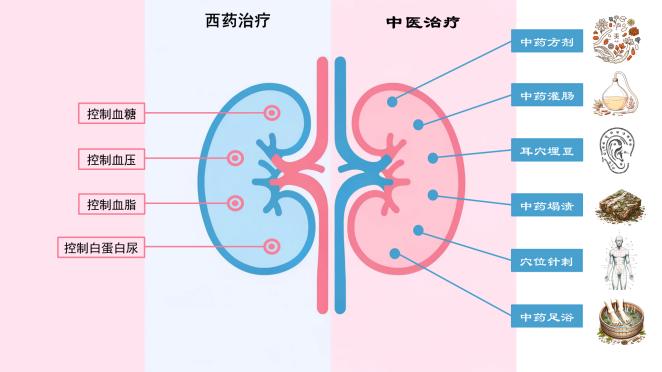
(A) Western medicine treatment
1. Blood sugar control: oral hypoglycemic drugs or insulin are used for treatment, and the goal is to control fasting blood sugar and postprandial blood sugar in an ideal range.
2. Blood pressure control: the use of angiotensin converting enzyme inhibitors or angiotensin II receptor antagonists can not only control blood pressure, but also reduce proteinuria excretion.
3. Blood lipid management: lowering cholesterol level through statins and reducing the risk of cardiovascular events.
4. Improve lifestyle: suggest a diet with low salt, low sugar and moderate amount of high-quality protein, and control the total calorie intake. Avoid smoking and excessive drinking to reduce the damage to the kidneys.
5. Monitoring and prevention of complications: regularly check renal function, proteinuria and other indicators to prevent cardiovascular diseases.
(2) Chinese medicine treatment
1. Chinese medicine treatment: The main principles of Chinese medicine in treating diabetic nephropathy are nourishing yin and tonifying kidney, clearing away heat and promoting diuresis, invigorating qi and strengthening spleen, and promoting blood circulation to remove blood stasis. According to different people’s symptoms and constitutions, we can adjust the internal environment of the body, improve renal metabolism, effectively reduce proteinuria and delay the progress of renal function through different ways of oral administration of traditional Chinese medicine.
2. Treating both inside and outside: by taking Chinese medicine orally and enema with Chinese medicine externally, two-way detoxification, diuresis and detumescence can delay the progress of renal function.
3. Acupuncture treatment: Acupuncture can regulate the balance of qi, blood, yin and yang and the function of viscera by stimulating specific acupoints, and promote the recovery of kidney function.
4. Massage: Through massage on specific parts and acupoints of the body, the circulation of qi and blood and the balance of qi and blood are promoted, and the body’s resistance is enhanced.
5. Traditional Chinese medicine characteristic therapy: acupoint application, acupoint injection, ear point pressing beans, Chinese medicine foot bath, hot bag, Chinese medicine fumigation and washing, etc.
6. Dietotherapy: Chinese medicine believes that food is also medicinal, and it is recommended to eat foods that are beneficial to the kidneys, such as black beans.
7. Emotional recuperation: through psychological counseling and TCM health care methods, such as Tai Ji Chuan, Qigong, etc., adjust emotions and reduce stress.
Typical case
//
Patient, female, 45 years old. Diagnosed as diabetic nephropathy, renal function decreased in November 2021, and urinary microalbumin/creatinine: 651 μ g/mg; Serum creatinine was 123μmol/L and EGFR was 46 ml/min. Dry mouth, fatigue, cracked tongue, thin yellow fur, varicose veins under the tongue, and thready pulse. Diagnosis of traditional Chinese medicine: quenching thirst, invigorating qi and nourishing yin, promoting blood circulation and removing blood stasis, reusing Astragalus membranaceus 45g for invigorating qi and strengthening spleen, and combining with Ganoderma lucidum, Polygonatum sibiricum, Fructus Corni, Rhizoma Atractylodis, Cicadae cicadae, etc. The patient was treated with insulin and antihypertensive drugs at the same time. After three months of treatment, the creatinine decreased to 94μmol/L, eGFR increased to 64ml/min, and later the patient stopped the traditional Chinese medicine treatment and the serum creatinine increased to 143 μ mol/L. The eGFR decreased to 35 ml/min, and if it continues to progress, hemodialysis treatment may be needed. However, after three months of treatment with the above traditional Chinese medicine decoction, the serum creatinine decreased to 99μmol/L again, and the eGFR increased to 62ml/min. At present, the condition is stable. This typical case fully shows that Chinese medicine has a significant effect on improving urinary protein and renal function of diabetic nephropathy, and it is helpful to delay the progress of the disease.
six
summary
Traditional Chinese medicine has unique advantages in reducing urinary microalbumin and protecting renal function in the early stage of diabetic nephropathy. Traditional Chinese medicine has few side effects and is relatively safe. Many drugs are homologous to medicine and food. Traditional Chinese medicine has a unique effect in preventing and treating diabetic nephropathy complicated with hypoproteinemia, thrombosis and renal insufficiency. The comprehensive intervention measures of integrated traditional Chinese and western medicine are helpful to the overall adjustment and improvement of diabetic nephropathy patients complicated with various chronic diseases (such as hypertension, hyperlipidemia and hyperuricemia). Early detection, early prevention, integration of traditional Chinese and western medicine, doctors’ efforts, patients’ cooperation and family supervision, let us participate together and manage diabetic nephropathy together.
(Image from the Internet)
Contributed by: Shanghai Medical Association Nephrology Branch
Author: Gui Dingkun Shanghai Sixth People’s Hospital
Audit: Wang Niansong, Chairman of Shanghai Medical Association Nephrology Branch.
The Nephrology Branch of Shanghai Medical Association was established in 1980. Since 2006, during the annual "world kidney day", it has actively carried out publicity activities on the prevention and treatment of nephrology, and escorted the life and health of patients with nephrology in various forms, such as popular science lectures, health consultation, online interaction, and manual exhibition boards.
Shanghai Medical Association actively exerts its own advantages to open up a new situation of medical science popularization. Continue to carry out three series of brand activities: "Healthy Steering Wheel", "Building Rainbow Bridge" and "Young Medical Science Popularization Ability Competition". The young medical science popularization ability competition has become one of the most influential medical science popularization competitions in Shanghai and even the whole country, which has trained a large number of young medical science popularization talents, created a four-stage science popularization stage with feelings, temperature, inheritance and innovation for young medical workers in the new era, and contributed to the goal of building a well-off society in an all-round way.
Read the original text